Showing posts with label cyprus invasion. Show all posts

Sunday, 18 October 2009

(1940-1990s) Marmon-Herrington

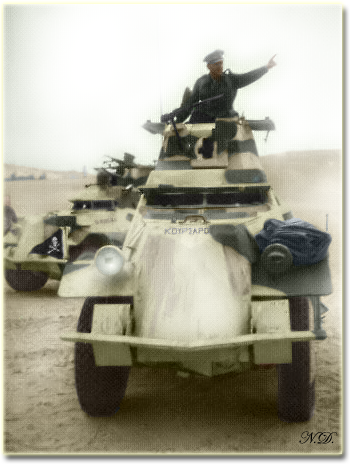
Greek Marmon-Herrington Mk.III in North Africa. The specific one's name is 'Koursaros', which means 'Corsair'The Greeks were given a small number of Marmon-Herrington I armoured cars that participated in the defence against the Germans. Later, the Greek army in the Middle East received two Marmon-Herrington III armoured cars, and several more, of the IVf type, after the liberation in 1944. IV was a complete redesign. It had a monocoque hull, had its engine mounted at the rear, not the front, and had a larger, two-man, turret, in place of the original one-man turret. Some IVfs remained in service until the 1990s.

I recorded this video during the Bovington Tank Fest of June 27, 2010. It's a Marmon Herrington IV which was given to Greece after World War II, probably during the Civil War:


Operational History

1945-1949 - During the Greek civil war, IVF armoured cars have their mechanical parts removed and are placed on flat wagons to protect trains.
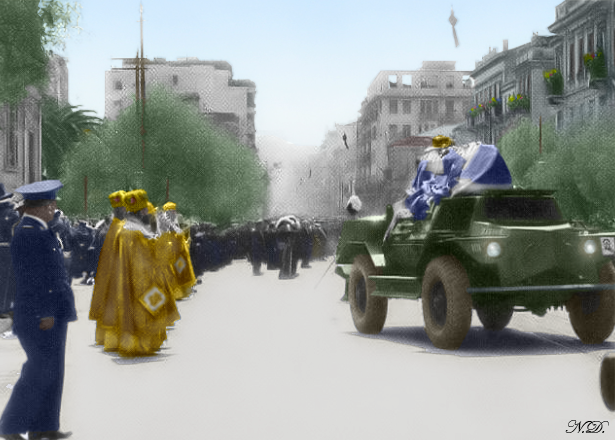
Marmon-Herrington IVF carrying the body of King George II (April 1947)1974 - At the time of the Turkish invasion of Cyprus, the Cypriot army has 45 Marmon Herringtons.
1990s - The Greek army is still using Marmon Herringtons in mechanised infantry battalions in the Aegean Islands.


Specifications
Marmon Herrington Mk.II/III armoured car
Crew: 4
Weight: 6 tons
Length: 5.31 m
Height: 2.49 m
Width: (II) 1.98m / (III) 2.29 m
Armour: 12 mm
Engine: 8-cylinder Ford petrol. 85 hp
Speed: 80 km/h
Operational Range: (on-road) 322 km, (off-road 193 km)
Armament: 1x 0.55" Boys Anti Tank rifle, 1x 7.92mm Bren MG, 1x 7.7mm vickers AA MG

Marmon Herrington Mk.IVF armoured car
Crew: 4
Weight: 6.4 tonnes
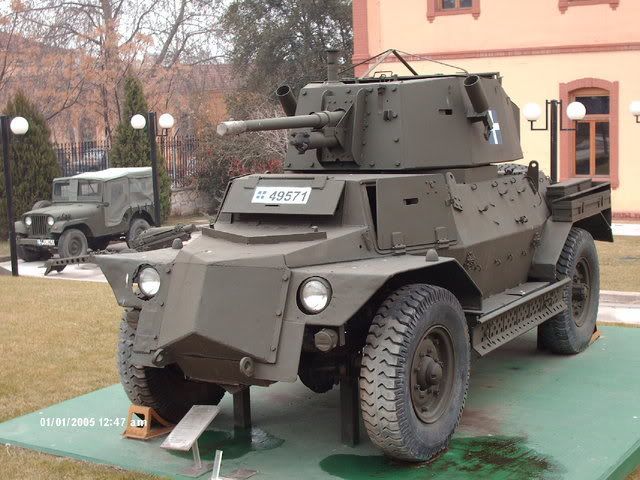
Marmon-Herrington IV outside the War Museum of ThessalonikiLength: 5.51 m
Height: 2.29 m
Width: 1.83 m
Armour: 20 mm
Engine: 8-cylinder Ford V90 petrol. 95 hp (71 kW), 3600 rpm
Speed: 80 km/h
Operational Range: (on-road) 322 km, (off-road 193 km)
Armament: 1x 40mm QF 2-pdr, 2x 7.92mm Browning MG

For gamers and game designers
Being one of their few modern armoured vehicles, the Marmon Herrington was invaluable to the Greek forces.

For modellers


A Marmon-Herrington IV from the Army's Grove in Goudi, Athens. Photos by Xristos of modelclub.gr:
Marmon-Herrington IV from the Army's Grove in Goudi, Athens

A scale model of the Marmon-Herrington from the War Museum in Athens.

Marmon-Herrington scale model

Saturday, 2 May 2009

(1964-1993) F-104 Starfighter

Greek F-104 Starfighter outside the National War Museum in AthensIn 1964, following the Turks, the Greeks acquired their first F-104 Starfighters under the US Military Assistance Program (MAP); F-104G fighter-bombers and TF-104G trainers. Later they acquired several second-hand ones from other NATO countries, including RF-104Gs for reconnaissance. The Starfighters gained a "flying coffin" reputation, especially in Germany where 292 of the 916 crashed. In Greece, at least 11 pilots were lost between 1965 and 1987.

Operational History
F-104G Starfighters arriving in Greece
1964 - Greece acquires 45 F-104Gs (35 built by Canadair and 10 by Lockheed) and 6 two-seat trainer TF-104Gs (Lockheed) under MAP funding. They arrive at 114 Combat Wing and the new 335 Fighting and Bombing Squadron is formed with them.
1965 - 336 Strike Squadron is equipped with F-104s.
1971 - Greece acquires 3 second-hand TF-104Gs from West Germany.
1972 - Greece acquires a further 9 second-hand F-104Gs and 1 TF-104G from Spain.
1982 - Greece acquires a further 10 second-hand F-104Gs from the Netherlands.
A F-104 Starfighter on a Greek stamp1981-1988 - Greece acquires a further 38 F-104Gs, 22 RF-104Gs and 17 TF-104Gs from West Germany.
March 1993 - The F-104s are phased out of service.


Pilot losses (none in combat)
19/06/1965 - S. Nikolaou (F-104G, Tanagra Airfield).
15/07/1965 - C. Efstathiou (F-104G, Tanagra Airfield).
31/07/1972 - A. Damianidis and C. Filippou (TF-104G, Ileia).
24/02/1976 - S. Roulias (F-104, Araxos; parachute didn't open due to low altitude).
21/10/1978 - D. Bibikos (F-104G, sea near Loutra Kilinis).
22/01/1979 - K. Davillas (F-104G, Prof. Ileia hill, Achaia).
15/01/1980 - S. Papastavrou (F-104G, Preveza).
15/04/1980 - S. Bourtzinakos and S. Laourdekis (TF-104G, sea NW of Araxos).
23/09/1987 - S. Zografos (F-104G).


Specifications
F-104G Starfighter, 1st Generation Jet Fighter-Bomber

Weight: Empty 6,350 kg, Loaded 9,365 kg, Max takeoff 13,170 kg
Length: 16.66 m
Height: 4.09 m
Wingspan: 6.36 m
Wing Area: 18.22 m²
Rate of climb: 244 m/s
Speed: 2,125 km/h
Ferry Range: 2,623 km
Combat Radius: 670 km
Crew: 1
Armament: 1x 20 mm M61 Vulcan gatling gun (725 rounds). 7 handpoints with a capacity of 1,814 kg. Provisions to carry combination of 4x AIM-9 Sidewinder missiles, Bombs, rockets, etc.
Engine: General Electric J79-GE-11A afterburning turbojet. Dry thrust: 10,000 lbf (48 kN). Thrust with afterburner: 15,600 lbf (69 kN)
Ceiling: 15,000 m

For gamers and game designers
...


For modellers Greek F-104 Starfighter schematic
The original MAP-funded Starfighters were in metal finish, but later the fleet started getting a disruptive pattern of olive drab / dark green / sand on top and light gray on the bottom. A nice silver Starfighter made by D. Georgiadis can be seen in the following photo:
F-104G model by D. Georgiadis
A model from IPMS-Hellas 2006:
F-104G model from IPMS-Hellas 2006