Saturday, 5 February 2011

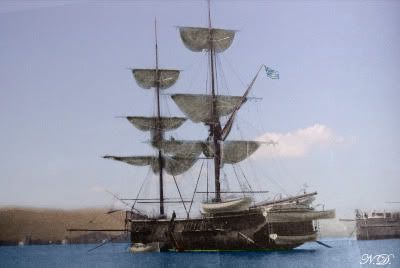
(1826-1840) Paddle Steamer Karteria

KarteriaBuilt in London for the Greeks, Karteria was possibly the most modern warship in the world when it entered service in 1826. She was ordered, part financed and captained by retired Royal Navy officer, Captain Frank Abney Hastings.

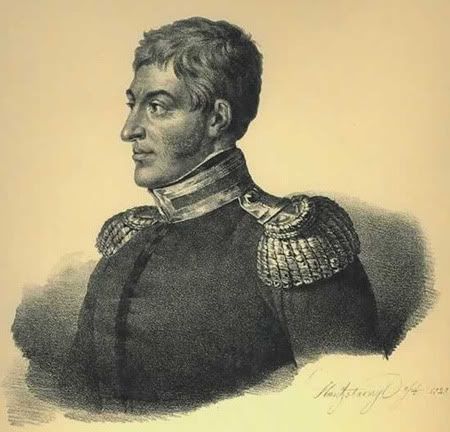
At the age of 11, Hastings had taken part at the Battle of Trafalgar on HMS Neptune. He rose to commander until 1820 when due to an incident with a senior officer he was Hastingscompelled to leave the service. A great philhellene, in 1822 he went to Greece to serve on Tombazis’s ship "Themistoklis". In 1824, he managed to secure £10,000 of the £2,000,000 of the second Greek loan from England, to finance Karteria; he paid for her guns himself. A year later, he was appointed commander-in-chief of the Greek revolutionary navy.
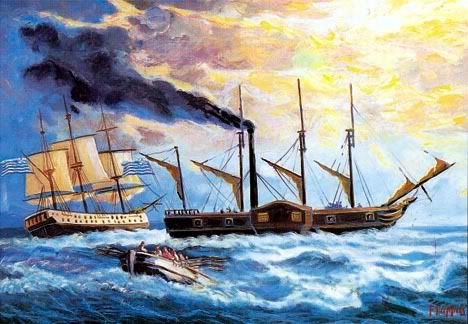
Karteria was classified as a four-masted sloop-of-war that operated under sail while travelling, but could be propelled by steam-powered paddles in battle. Captained by Hastings, armed with 68-pounder guns and equipped with on-board furnaces to provide red-hot incendiary shots, Karteria was deadly against the older wood and sail ships of the Ottoman navy. In 1827 alone, she fired 18,000 rounds and sank several enemy ships.

Karteria is most notable for being the first steam warship in the world to be used in battle (the first steam warship built was the American USS Demologos from 1814). Apart from Karteria, five more steam warships were ordered. Two of them, "Epiheirisis" and "Ermis" entered Greek service before the war was over, one blew up during trials and two were never completed and were left to rot on the Thames.

Hastings is buried in Poros and his heart is immured at the Anglican church of St. Paul in Athens.

Maurice Abney-Hastings, antecedent of Hastings, provides an excellent relevant article by Dimitri G. Capaitzis in his website (www.captainfrank.co.uk). The two quotes below are taken from there:
____________
Materials used for construction are described by Hastings, in his Memoir of 1828:

The ‘Karteria’ was built with her timbers close and caulked together, and would therefore, have floated without planking. I had several opportunities of remarking the advantage of building thus, to resist shot; nothing less than a eighteen pounder ever came through us; this, ’tis true, might be partly attributed to Turkish bad powder, but those shot that did come through, always made a nice clean round hole without a splinter. However, against shells it would have a disadvantage, as they would be more likely to stick in it. Perhaps if shells became generally used, it will be proper to make the upper works of a ship as slight as is consistent with strength, and iron ribs might perhaps be good. The ‘Karteria’ had another peculiarity in her build – two solid bulkheads enclosing the engine room, and caulked and lined, so as to be water tight, the intention of this was, in the event of one part of the ship being leaky from any cause whatever, the water could not flow into another part of the ship. This arrangement, which is due to the ingenuity of Mr Brent, the builder, once saved this ship from fire, which broke out with great force in the after-part of the engine room, and would have communicated to the shell room very quickly. But for this bulkhead, which kept the fire forward, and gave us time to subdue it. I see no reason why all men of war should not be furnished with similar partitions. The same builder saved another ship (the Rising Star) from sinking, by this contrivance.

Samuel Gridley Howe, the ‘Karteria’ American doctor had recorded in his November, 1826 journal:

We have two Englishmen (officers), one German, one Frenchman, and one Greek; The Greek is the eldest son of Tombazi, Captain Hastings is a man who deserves the deepest gratitude and respect from the Greek nation. It is only through his exertion, his activity, and generosity, that this ship was ever got out. She was built under his own eye in London, and carries as much weight of metal as a thirty-six gun frigate; her engine, however, is not the best. Captain Hastings, having on board about forty English and forty Greek sailors, is all ready to join the Greek fleet and engage the enemy.
__________________


Operational History
1825 - Laid down at Daniel Brent's Greenland South Dockyard, Rotherhithe, London, for the Revolutionary Greek navy. The order was financed by the London Philhellenic Committee.
KarteriaMay 1826 - Completed.
September 1826 - Reaches Nafplion.
January 1827 - Sails to Phaliron and sees action in both sea and land engagements. She is accompanied by three brigs and five gunboats.
February 1827 - Sails to Oropos and attacks enemy coastal defences and ships, together with Papanikolis' "Nelson" and Miaoulis' frigate "Hellas". Two transports loaded with equipment and supplies are captured and taken to Poros.
March 1827 - Cochrane takes over as commander of the Greek navy and orders Karteria to lead operations off Volos, together with schooner "Themistoklis", brigs "Aris" and "Panagia" and sloop "Aspasia". Shore defences are destroyed, five loaded transports are captured, two are destroyed and one runs aground. At nearby Trikeri they attack a large warship and four beached captured schooners. All are destroyed by firing from a distance.
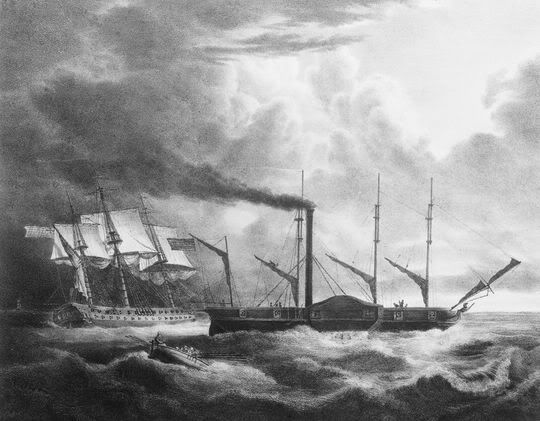
Karteria in front of frigate Hellas, from the National Maritime Museum Greenwich, by Karl KrazeisenSeptember 1827 - Karteria, Hellas, two schooners, twelve brig and three gunships proceed to Vasiladhi and Mesolonghi to take part in the Greek land offensive. They have limited success and the fleet is split.
29-30 September 1827 - Hastings with "Karteria", "Sauveur" and gunboats "Bavarois" and "Philhelleic" pass into A remake of the original painting, in colour, by unknown artistthe Gulf of Corinth and enter the Gulf of Salona, to engage one Algereen brig of 14 guns, the enemy Admiral’s 16-gun brig, three small schooners, two armed transport brigs, two large boats with guns, shore batteries and three loaded Austrian transport ships. The Admiral’s brig is set on fire, as well as one schooner and one transport brig, while the Algereen brig is abandoned. Out the nine enemy ships only two are spared. The three Austrian ships are taken as prizes. This success provokes Ibrahim Pasha Karteria on a stampinto the aggressive movements that would lead to his fleet's complete destruction by allied fleet of England, France and Russia at the Battle of Navarino (20 October 1827).
25 May 1828 - Hastings is wounded in an attack at Aetoliko.
1 June 1828 - Hastings succumbs to his wounds in the Harbour of Zante. He is given a state funeral with full military honours and hailed as a great hero by the leaders of the soon to be born Greek State.
February 1830 - Following last September's Treaty of Adrianople, Britain, France and Russia recognise a free Greek State.
16 July 1831 - During one of the first civil conflicts of the new state, where the Hydriots revolt against the State, Karteria is used by the Hydriots to take position west of Galatas, Poros.
27 July 1831 - Together with Hellas, Karteria engages two Russian ships that support the Greek State.
1 August 1831 - Miaoulis sets fire on his fleet at Poros, including the frigate Hellas. Karteria and old two-masted "Emmanouil" are saved by Myconian sailor George Galasidis and another soldier, who swam to the ships and managed to cut the fuses just in time.
1841 - Karteria is officially no longer mentioned in the Greek navy's lists, although it is practically out of commission for almost a decade.

Specifications
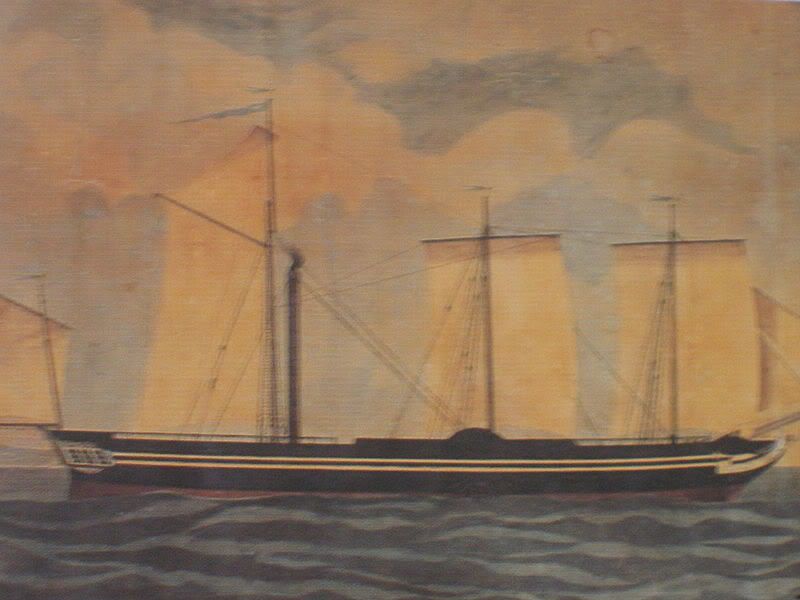
Watercolour of KarteriaPaddle Steamer "Karteria"

Displacement: 233 tons
Propulsion: two steam enginers of 85hp and four masts with schooner rigging
Consumption: 7 tons of coal per day
Speed: 7 knots
Length: 38.4m
Width: 7.6m
Armament: 4 x 68-pounder carronades and 4 x 68-pounder guns of a new design based on a model by Frank Hastings
Crew: 185 (17 officers, 22 petty officers, 32 gunners, 110 sailors and 4 cooks-cabin boys)

For Gamers and Game designers
Being the first steam warship to see action and able to fire red-hot incendiary shots from its 68-pounder guns, Karteria offered a spectacular advantage against the Ottoman navy (and possibly any other navy at the time). Also notice that she travelled under sail and the steam engines were used only in battle.

For Modellers
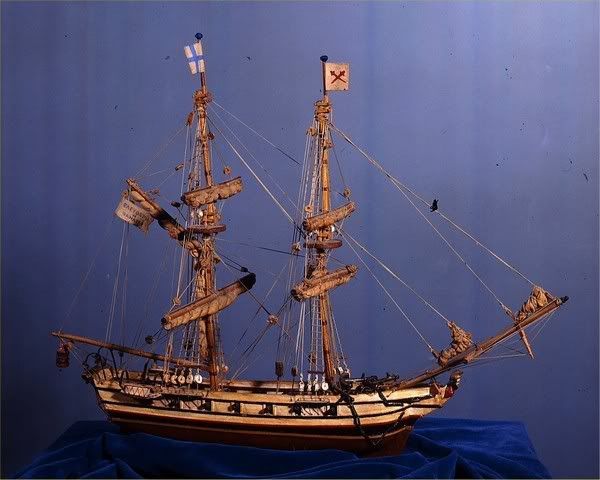
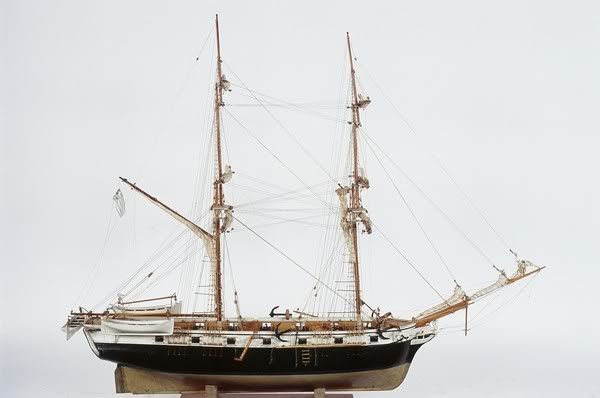
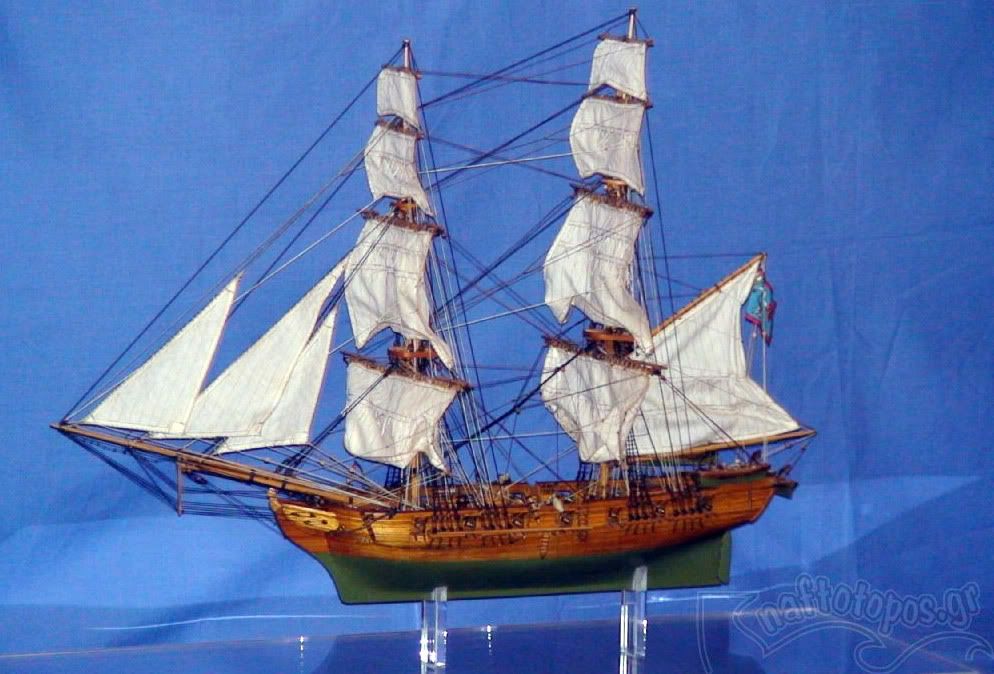
The first two images are of the model of Karteria by G. Vammenos, which can be seen at the Hellenic Maritime Museum, Piraeus. The third image is Karteria's model at the Hellenic Naval Academy's museum.
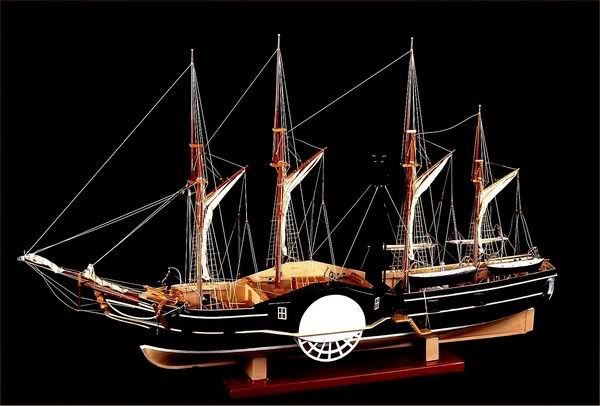
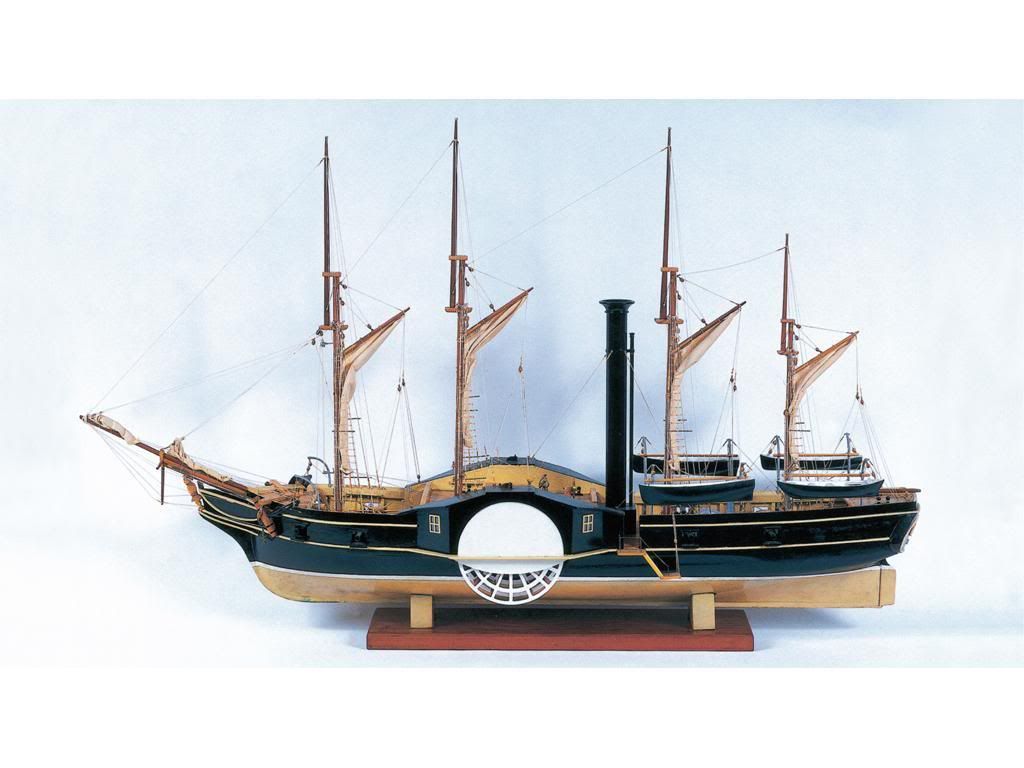
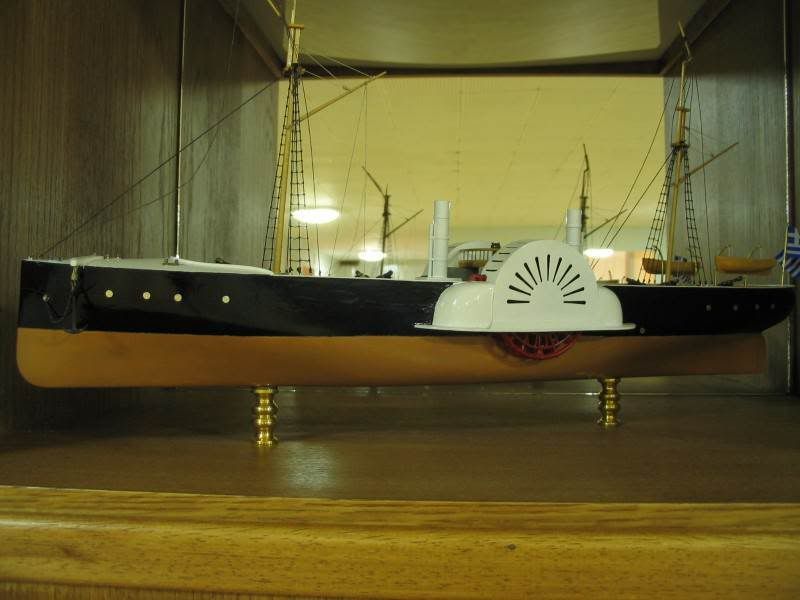
Model of Karteria by G. Vammenos Model of Karteria Model of Karteria by G. Vammenos

Wednesday, 19 January 2011

(1819-1921) Brig "Aris"

Aris (Poros, 1905)Provided by Hydriot Anastasios Tsamados, the Brig "Aris" participated in several naval operations during the Greek War of Independence.

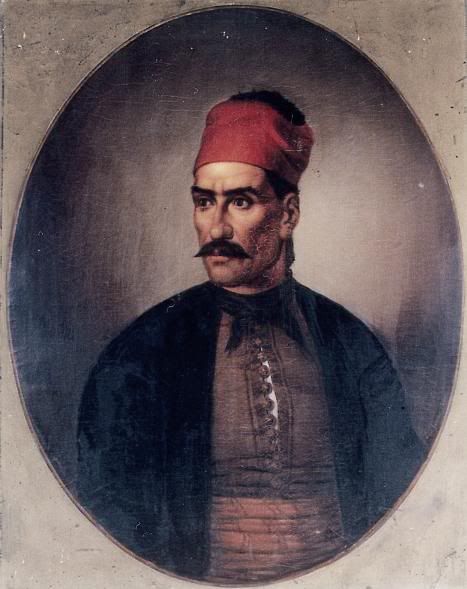
Aris gained fame for successfully breaking the Egyptian Blockade of Navarino in 1825. At the time, a Greek garrison was quartered at the island of Sphacteria, which controlled the entrance to Navarino's natural harbour. Ibrahim Pasha of Egypt, tasked by the Sultan to suppress the Greek revolt, needed to take the island. When the combined Turkish-Egyptian fleet started bombarding Sphacteria and disembarking its 3,000 troops, the six Greek brigs stationed there were taken by complete surprise. Most of their captains were on land, along with part of their crews, manning the island's defences. Five of the brigs managed to sail before the enemy fleet sealed off the bay, and following a brief skirmish were able to Anastasios Tsamadosescape. "Athina" (not to be confused with Aris's post-war name, which was also "Athina") sailed without her captain, Nikolaos Votsis, and narrowly escaped. The crew of Aris, however, still waited for their captain, Tsamados, who was defending heroically on land although already shot in the leg and fighting on his knees. During the Battle of Sphacteria, 350 of the 800 defenders were killed. When they found out that Tsamados was knocked down and killed, Athina's captain, Votsis, took over as commander, with Dimitrios Sachtouris, the commander of the Navarino fortress, as first mate. Also present on the ship was the Secretary of State, Aleksandros Mavrokordatos, who was sent to the ship for safety.

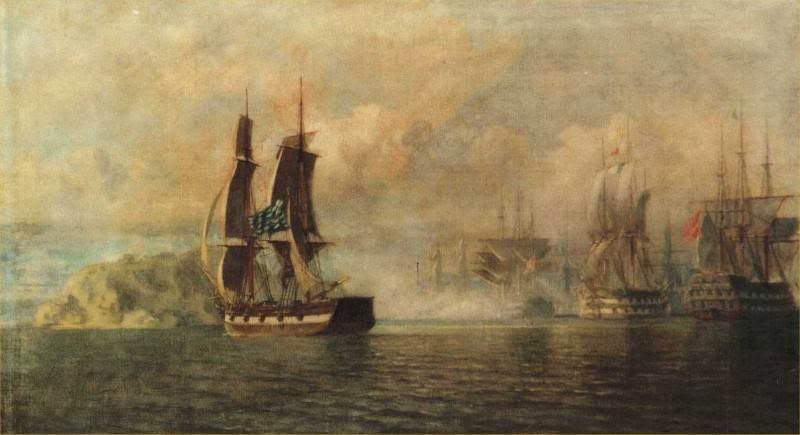
Painting by Iosif Demiris (1945- )Displaying superb seamanship, Aris set sail through the midst of the Egyptian fleet, being attacked from all sides and exchanging fire for over four hours with several of the 32 enemy ships. At one point, five Egyptian ships tried to ram it. With exceptional display of gunnery, Aris sank one and drove away the other four. Badly damaged, Aris exited the bay. Casualties among the crew were two dead and six wounded. It was time for the icon of the Virgin Mary to be brought up on deck by the sailors.

What followed next is unclear. According to one version, Aris was then attacked by an enemy frigate that tried to ram it, but changed course at the last moment when they heard Votsis ordering his sailors to set fire to their own powder magazine. According to another version, Aris was under full sail when obstructed by two frigates, which she avoided by demonstrating superb seamanship and causing them some damage with her guns. The exit of Aris amidst the 32 enemy ships is depicted in a masterpiece by Volanakis.

The Exit of Aris (by Volanakis)

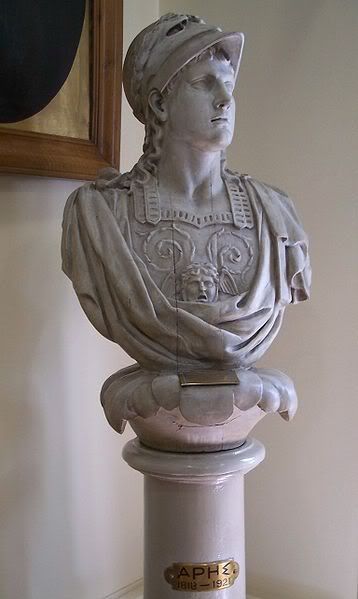
Aris was preserved until 1921, The figurehead of Aris, displayed at the National Historical Museum, Athens100 years after the War of Independence, when due to the country's financial difficulties it was sunk near the Naval Base of Salamina. Many had objected and had insisted on the preservation of Aris as a historical ship, but all that is left today is its figurehead at the National Historical Museum in Athens, and surprisingly (and unknown to most people) one of its masts at the Naval Base of Salamina. The mast was actually used for several decades as a mast for signalling purposes, slowly decaying. Its significance must have been realised recently, as it has been replaced and repaired and presumably is preserved somewhere inside the base.

Operational History
1807 - Built in Venice as a merchant ship.
1819 - Hydriot Anastasios Tsamados buys the ship
1821 - Aris is armed with 16 cannon and 82 crew and is included in the Hydriot Squadron, with with she participates in almost all naval operations and battles in the Aegean, the Peloponnesian Coast and the Corinthian Gulf.
The Exit of Aris (painting at the Hellenic Naval Academy's museum)26 Apr. 1825 - Successfully breaks Ibrahim Pasha's blockade and escapes to the open sea.
After the liberation - Purchased by the Greek Government and renamed "Athina".
1863-1865 - Used as a school for Naval Cadets
1882-1885 - Used as a school for lower personnel
1879 - Renamed again "Aris".
25 Mar. 1921 - Due to financial difficulties of her upkeep, Aris is sunk by honorary salvoes near the Kyra Islet off Salamina Naval Base, during the celebrations for the 100 years since the War of Independence.


Painting of Aris by A. Kriezis

Specifications
Brig "Aris" ("Athina")

Displacement: 350 tons
Propulsion: Sail
Length: 30.5m
Width: 8.8m
Draft: 4.9m
Armament: (As built) 16 x 22-pounder cannon, (later) 2 x 12-pounder cannon and 10 x 24-pounder carronades
Crew: 82


For Gamers and Game designers
Until the arrival of steam ships, Brigs, such as Aris, were particularly popular thanks to their speed and manoeuvrability. Their main weaknesses were the fact that they needed relatively large crew to handle its rigging and that they could not easily sail into the wind.


For Modellers
The following are two models of Aris found in the Hellenic Maritime Museum, Piraeus, and a model by Aristotelis Rallis from www.naftoporos.gr.

Model of Aris Model of Aris by G. Vammenos Model of Aris by Aristotelis Rallis

Sunday, 14 November 2010

(1942-1945) Sacred Band

Sacred Band in North AfricaIn 1942, there appeared to be disproportionately many officers in the Greek army fighting in the Middle East. To address this issue, a special foces unit was formed that was composed entirely of officers and officer cadets. In reality, many of the "officers" were simple soldiers who had fled to Turkey and had been told (presumably erroneously) that they couldn't join the army in North Africa unless they were officers. The unit, initially named "Company of Chosen Immortals" was formed under Cavalry Major Antonios Stefanakis in Palestine, with 200 men, 130 of which were officers. It was organised as a Machine Gun Company and intended to be attached to the II Greek Brigade. This changed when its new commander Col. Christodoulos Tsigantes took over. Tsigantes was an ex-Venizelist, who had taken part in the attempted coup of 1935. His first move was to get rid of those who were openly leftist and any others he considered troublemakers. Using his close relations with officers in the Allied HQ, he applied and succeeded in converting the unit into a special forces unit, which he renamed "Sacred Band". After intensive training in the British SAS camp in Cairo and additional training in Palestine, the Sacred Band was placed in battle in El Alamein and Tunisia. By then it numbered 400 men. Until August 1945, when it was disbanded, it fought alongside the SAS in the Libyan desert and the Aegean, as well as with General Leclerc's Free French Forces in Tunisia. The Sacred Band of 1942-45 is the precursor of the modern Greek Special Forces and some of its traditions are carried on by the Mountain Raiding Companies (LOK), founded in 1946.

Operational History
1942 - In close cooperation with the commander of the British SAS Regiment, Lt. Colonel David Stirling, and with the approval of the Greek HQ, the company moved to the SAS base at Qabrit in Egypt to begin its training in its new role.
17 Nov. 1942 - 27 Jan. 1943 - 8 men under G. Alexandris operate with the SAS behind German lines in Cyrenaica.
4 Dec. 1942 - 60 men move towards Benghazi to perform SAS-like sabotage raids, but the mission is cancelled due to the rapid advances of the British.
27 Jan. 1943 - Following special training, the Sacred Band moves west to join the SAS in raids behind German-Italian lines. The mission is cancelled due to recent heavy losses of the SAS and the capture of its leader, Stirling.
7 Feb. 1943 - Following Colonel Tsigantes's suggestion, General Montgomery puts the Sacred Band under the command of General Leclerc of the Free French 2nd Armoured Division, with the duties of Light Mechanised Cavalry.
10 Mar. 1943 - In Ksar-Rillan, Tunisia, the Sacred Band gives its first battle against a German mechanised detachment, while covering the advance of the X British Army Corps that try to by-pass the Mareth defence line from the South.
29 Mar. 1943 - After the Allied forces capture Gabès, Tunisia, the Sacred Company is detailed to the 2nd New Zealand Division
6 Apr. 1943 - A mixed Greek-New Zealand detachment fights against the Germans at Wadi Akarit.
12 Apr. 1943 - The Sacred Band enters Sousse, and participates in the battle for Enfidaville between April 13 and 17.
May 1943 - The Sacred Band, now composed of 314 men, moves to Palestine, in various camps.
July 1943 - It takes parachute training in Jenin and undergoes a reorganisation into an HQ Section, a Base Section, and Commando Sections I,II and III.
9 Sep. 1943 - The Italians capitulate and British forces start moving into the Italian-occupied Dodecanese islands.
1-17 Nov. 1943 - Section I of the Sacred Band is dropped by air to the Greek island of Sacred Band operation in the AegeanSamos, while sections II and III move there on fishing boats. With the failure of the campaign after the battle of Leros, however, Samos is evacuated, and the men of the Sacred Band withdraw to the Middle East.
Feb. 1944 - Put under the command of the British Raiding Forces.
7 Feb. 1944 - Section I moves for combat operations to the islands of the northern Aegean sea, while Section II moves to the Dodecanese with the same purpose.
29 Mar. 1944 - The Sacred Band liberates the island of Psara.
3 Apr. 1944 - 30 men perform diversionary attack in Mitilini.
Apr. 1944 - The Sacred Band attacks Ios, Paros and Amorgos. It also expands to regimental size, with a strength of around 1,000 men. This reflects the unit's effectiveness, and, from a British standpoint, political reliability in the face of mounting political tensions among the Greek forces in exile.
17 May 1944 - 31 men raid Samos and destroy selected targets
13-14 Jul. 1944 - A combined Greek-British force neutralises the 200-strong garrison of Simi and captures the island.
Sep. 1944 - Following sabotage raids in Thira, Ko and Karpathos, the Sacred Band with 25 men liberates Mykonos after neutralising its garrison (24-25 Sep.). A little later, it accepts the surrender of the Germans in Lesbos.
Oct. 1944 - The Greek mainland is liberated and the Sacred Band returns to Greece, where strains are becoming evident in the relationship of Papandreou's Sacred Band equipment displayed in the National War Museum, AthensBritish-backed national unity government and the leftist National Liberation Front (EAM), which controls most of the countryside. The crucial issue is the disarmament of the guerrilla forces and the formation of a new national army out of members of both the exiled armed forces and the guerrillas of ELAS and EDES. However, the Papandreou government wish to retain the Sacred Band and the 3rd Greek Rimini Mountain Brigade intact. Disbanding them would mean that their members would become individual recruits in a possibly EAM-dominated people's army. This tension eventually spills over into the Dekemvriana events in Athens, where the Sacred Band fights against the Communist ELAS forces.
In the meantime, elements of the Sacred Band escort Papandreou's government in its return to Athens, and parade in front of the people of Athens.
25 Oct. 1944 - 50 men raid Tilos and liberate temporarily the island. The island is re-captured by Sacred Band on a Greek stampthe Germans a little later.
11 Feb. 1944 - 114 men liberate the island of Nisiros.
25 Feb. 1945 - With the help of an Indian company, it neutralises the 200-strong German garrison of Tilos and re-captures the island.
28 Feb. 1944 - 513 men attack and liberate Tinos.
Mar.-May 1945 - The unit patrols the Dodecanese in armed fishing boats (kaikia), raids Alimia and and participates in the siege of Rhodes. 217 men operate during the night and neutralise all German coastal garrisons of Rhodes. The Germans surrender in Kos and Rhodes.
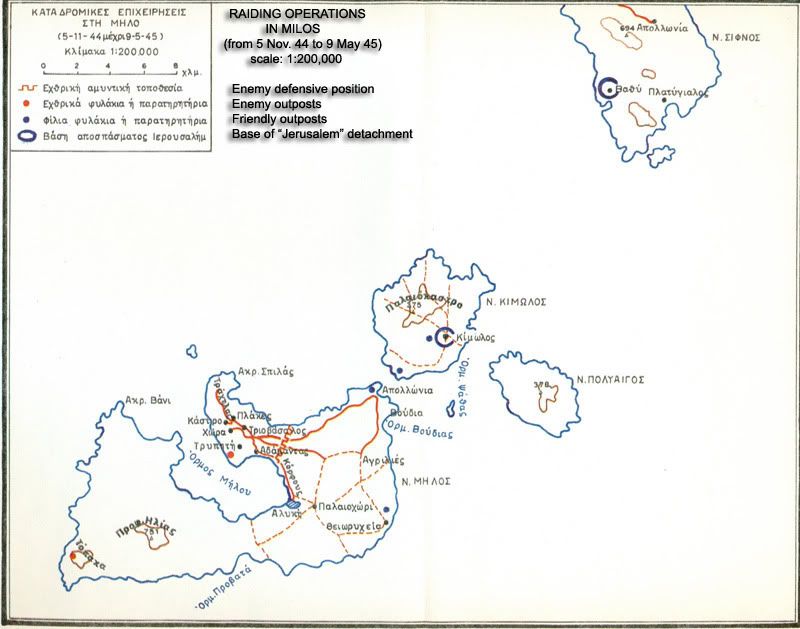
Sacred Band's raids in Milos3-4 May 1945 - Last raid is against the island of Milos.
June 1945 - The unit returns to Egypt.
7 Aug. 1945 - The unit disbands in a ceremony in Athens. During the ceremony the unit's flag is awarded with Greece's highest military awards, the Gold Cross of Valour and the War Cross First Class. The unit's casualties throughout its existence have amounted to 25 dead, 56 wounded, 3 missing and 29 taken prisoner.


For Gamers and Game designers
The Sacred Band was a properly trained special forces unit that operated in much the same way as the SAS. They were trained in jeep-borne and airborne operations, but their main expertise lied in amphibious island raids, usually in converted fishing boats.

For Modellers
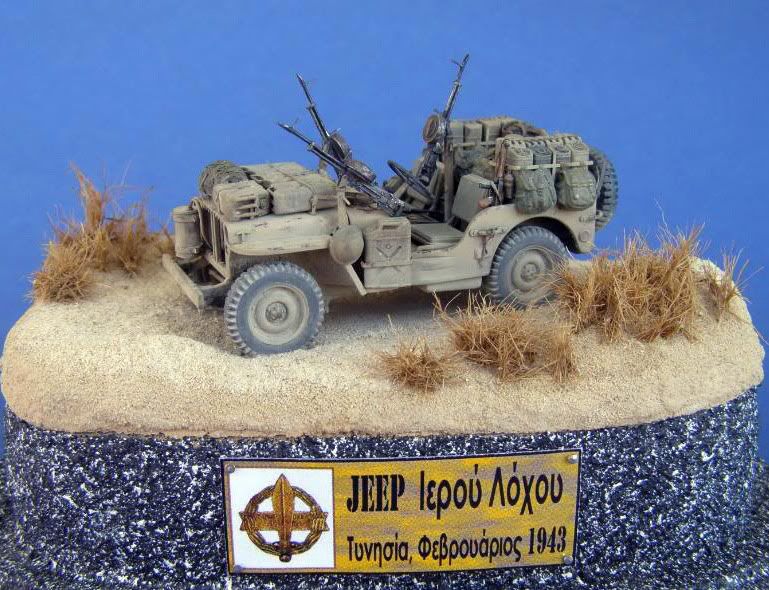
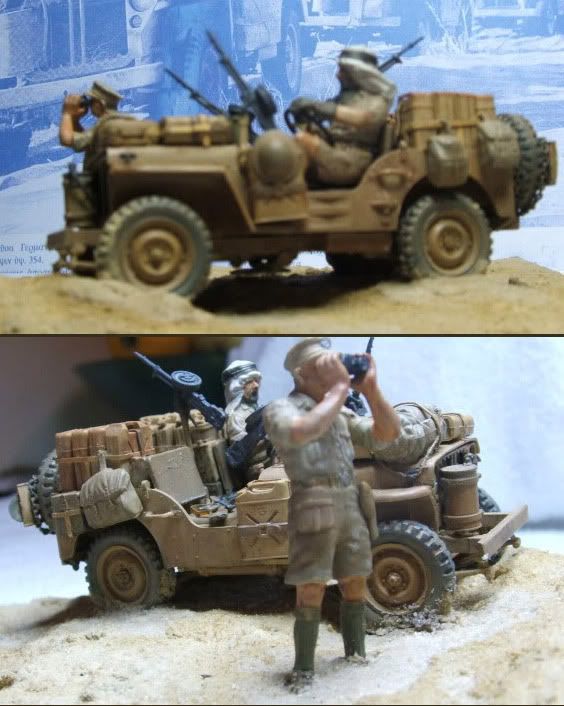
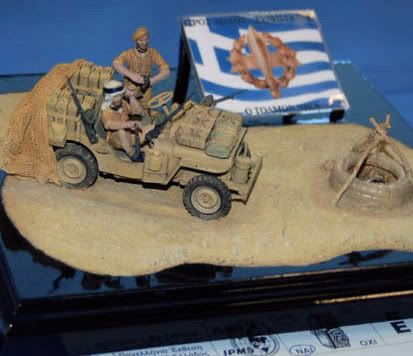
From left to right, Tunisia Feb. 1943 by Stavros of modelclub.gr, a model by pkpappas of modelclub.gr, and a model from IPMS-Hellas 2007:
Tunisia Feb. 1943, by Stavros of modelclub.r Model by pkpappas (modelclub.gr) Model from IPMS-Hellas 2007


Sunday, 31 October 2010

(1920-1936) Avro 504

The Hellenic Navy used two distinct versions of the Avro 504; the 504 K during the Asia Minor Campaign, and the 504 O/N during the interwar period.

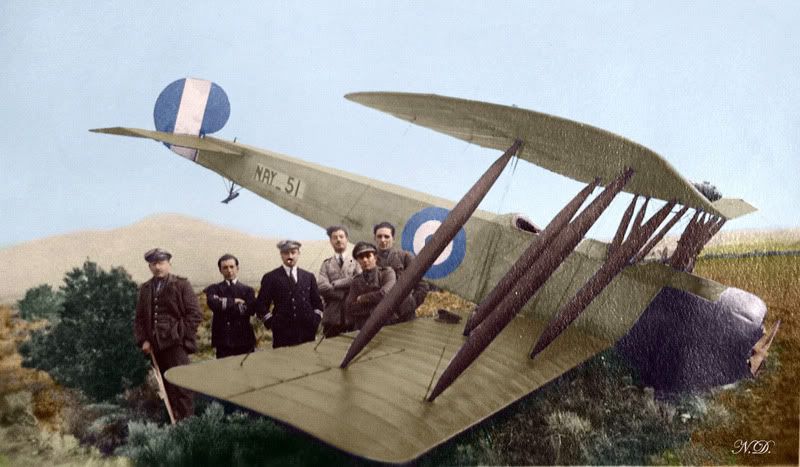
Near Dekeleia airport, following a forced landing during training. The plane belongs to the Naval Aviation Service (1920, from the collection of P. Tsekas)Greece received a small number of Avro 504 K trainers after World War 1. They were used to train pilots in Dekeleia during the Asia Minor campaign. The photo above shows a damaged plane belonging to the Naval Aviation Service (taken near Dekeleia airport in 1920; from the collection of P. Tsekas). The colours are not certain, but I chose clear doped linen, which is the most probable as the Greeks hadn't started using the silver colour yet.
Greek Avro 504 N
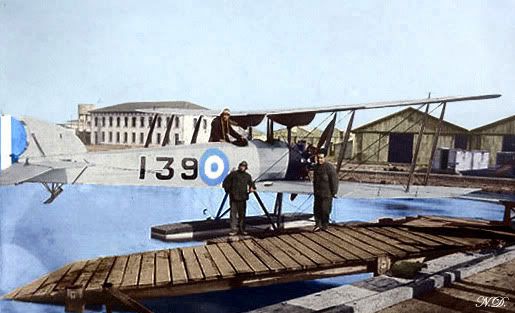
In 1925, the Greeks ordered six of the newest variant, the Avro 504 N/O, as part of a very large modernisation programme. The 504 N had a number of design modifications, with most important the use of the much stronger Armstrong-Siddeley Lynx engine. It also had new, modified ailerons, no top centre section of the top wing, two 18 gal. fuel Greek Avro 504 Otanks below the top wing instead of one on top of the top wing, as well as a new undercarriage.
The naval version, 504 O, was different in that a vertical stabiliser was added, and of course it had floats.

The text below is from a contemporary British publication describing the strengthening of the Greek Naval Air Force during the late 1920s:
_______________________________________
"The Director of the Greek Air Force at the Ministry of Marine, Captain Demestichas, during 1925 submitted to the Superior Council of Marine a long report, with suggestions for the reorganisation of the Naval Air Force.
Capt. Demestichas, as a justification of his views, recalls that practically all the countries, without excluding those neighbouring Greece, have for some time past considered the exceptional importance of aviation, as they are of the opinion that a powerful Air Force constitutes the best weapon for the defence of the country and is at the same time an efficient means to ensure the necessary mastery to the naval forces and the communications on sea.
A powerful airforce, Capt. Demestichas declares, will render important services, the principal being: to supply the first information regarding the enemy; to attempt the destruction of his naval forces and to attack the enemy fleet in its own base. For the whole duration of the war, the Air Force shall keep a constant watch on all the seas, chase and attack the submarines and the enemy ships; it will continually send wireless messages to the chiefs of the naval units during combats; it will discover the places where the enemy has put mines, so that the Greek ships may protect themselves against the danger; it will put up aerial fights against the enemy attacking, in conjunction with the Army Air Force, the means of communications and the military units; it will conduct the long-distance bombing by the big naval units; it will supply information regarding the movements of the enemy; it will facilitate the action of friendly ships by means of smoke bombs during the day and with illuminating bombs at night; Lastly, it will defend the country against aerial attacks by the enemy which, if not prevented, would have a disastrous effect on the morale of the inhabitants.
In order to achieve the above aims, it is essential to have aircraft of high speed and great manoeuvrability, so as to chase and destroy the enemy machines. It is also necessary to have aircraft for reconnaissance and for carrying out raids into the enemy's territory, and also heavy bombing machines and of long range, suitable in addition to be used for night work.
At the end of his report, Capt. Demestichas suggests the acquisition on the part of the Greek Government of 15-18 scout machines, 15-18 fighting and reconnaissance aircraft, 3 twin-engined machines for heavy bombing at long distance, 12 heavy bombing machines and 12 torpedo-carriers. He also suggests the purchase of 12 school machines for training purposes.
In this connection, it may be stated that 12 school machines have already been ordered, six of which are of the Avro "Lynx" type, which arrived in Greece at the end of April, 1925.
The purchase of all these machines demands a sum of about £400,000, and Capt. Demestichas suggests that these expenses should be entered in the balance-sheet of the Ministry of the Marine for the next two financial years.
The report, which has been considered by the Superior Council of Marine, was entirely approved and was communicated to the Ministry of Marine, to the Prime Minister and the Council of National Defence.
By special law published in 1925, a Greek Air Force Fund was endowed with a large amount of valuable property in Athens and other parts of Greece. Also, the Fund was authorised to collect voluntary contributions from all Greeks at home and abroad. By this organisation it was hoped that the Fund would collect sufficient finance to obviate the necessity of burdening the Budget with any special expense for the provision of an efficient Air Force.
According to recent information, the Municipality of Salonika has contributed sufficient money for the purchase of twenty-five aeroplanes, Kavala, the famous Macedonian tobacco town, has offered ten aircraft, and other Greek towns have offered smaller numbers. The result of the Fund would appear to be satisfactory.
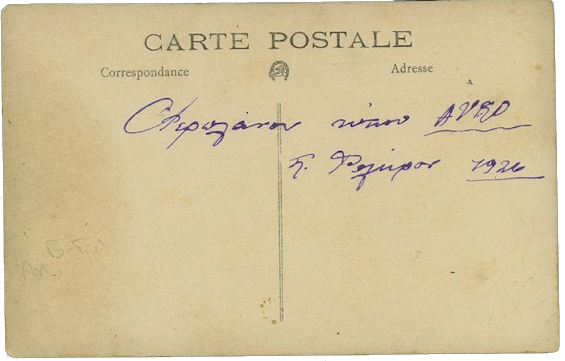
A Carte Postale reading 'Aeroplane type AVRO - Palaion Phaleron 1926' (source www.avro504.org)...
The chief Naval Air Station is at Phaleron Bay, with an additional Seaplane Base at Suda Bay, Crete, and the machines used up to the point of re-organisation were D.H.9s (240 h.p. "Puma" engines) for reconnaissance purposes and Sopwith "Camels" for pursuit purposes.
A number of Naval officers have been sent abroad for training, and from these will be selected the training staff for the new reorganised service..."

__________________________________

Operational History
1920-22 - A few Avro 504 K used for training during the Asia Minor campaign.
April 1925 - The first six Avro 504 O and N arrive in Greece.
1934-35 - The State Aircraft Factory in Phaliron constructs a small number of Avro 504 O and N aircraft, before turning into the licensed construction of Avro 621 Tutors.
1936 - Withdrawn from service. This date is not certain, as records show that between January 1938 and 28 October 1940, 28 Avro 504N/0 aicraft were repaired at the State Aircraft Factory.


Specifications
Avro 504 K
Length: 8.97 m
Height: 3.17 m
Wingspan: 10.97 m
Wing area: 330 sqr ft
Weight: (empty) 558 kg, (max take-off) 830 kg
Engine: 1 × Le Rhône Rotary, 110 hp (82 kW)
Armament: 1 × .303 in (7.7 mm) Lewis gun, up to 4x10⁴ kg bombs
Range: 402 km
Speed: (max) 145 km/h , (cruise) 126 km/h
Ceiling: 4,875 m
Climb rate: 3.6 m/s
Climb to 3,500 ft (1,065 m): 5 min
Crew: 2

Avro 504 N
Length: 8.69 m
Height: 3.33 m
Wingspan: 10.97 m
Wing area: 320 sqr ft
Weight: (empty) 718 kg, (max take-off) 1,016 kg
Engine: 1 x Armstrong Siddeley Lynx IV (of 160 hp or 180 hp) or Lynx IVC of 215 hp
Armament: 1 × .303 in (7.7 mm) Lewis gun, up to 4x10⁴ kg bombs
Range: 402 km
Speed: (max) 161 km/h
Ceiling: 4,450 m
Crew: 2


For Gamers and Game designers
One of the most successful trainers of its time, unusually for modern Greek history, the Avro 504N was a brand new model when the Greeks started using it.


For Modellers
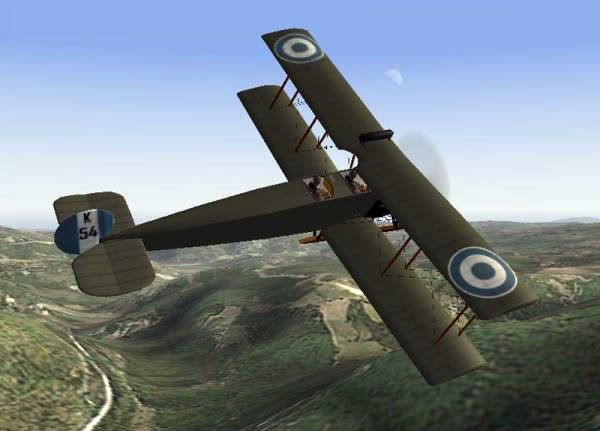
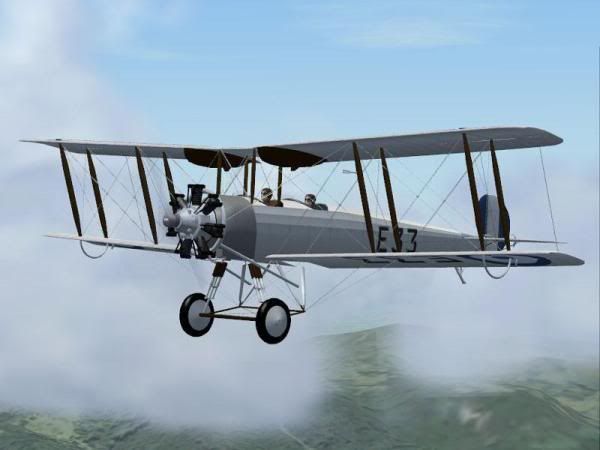
Manuele Villa's computer models of the 504K (left) and 504N (right) for MS Flight Simulator:
Manuele Villa's MS FS model of the 504K Manuele Villa's MS FS model of the 504N


Sunday, 24 October 2010

(1926-1939) Blackburn Velos

A Greek-built Blackburn Velos torpedo-carrier (450 hp Napier Lion Engine) taking off in Phaliron Bay
The "Velos" was the first airplane that was built under license in Greece. The basic design of the Blackburn Dart was developed into a two-seater to meet a Greek Navy requirement for a coastal defence seaplane that could be used for bombing, torpedo launching, reconnaissance and training. The aircraft became the T.3 Velos, a twin-float seaplane, which differed from the standard Dart T.2 in having a two-seat cockpit with a rear-mounted Lewis Gun, an increased weapons load and provisions to fly as either a seaplane with floats or with a conventional land undercarriage. In 1925, four were built at Brough Aerodrome for the Greek Navy. Later in the same year, the aircraft was chosen as the first licence-built aircraft in Greece in a factory built by Blackburn and operated under a five-year contract. The Aircraft Factory, later renamed the State Aircraft Factory or Greek National Aircraft Factory, produced 12 Greek-built T.3A Velos aircraft with a raised rear cockpit to give an improved field of fire for the observer and a larger radiator. They were equipped with specialised equipment like electric intercom system, a 200 mile range radio and bomb rails. The first of the production order flew in March 1926.

The Blackburn T.3 Velos fulfilled an operational role as a coastal defence/torpedo bomber in the Naval Air Component Squadrons in Greece and helped establish an indigenous aviation industry. The aircraft began operations in 1926 with the Greek Navy deployed at Tatoi Aerodrome and Phaliron Bay, Athens. It remained in squadron use until 1934 with all examples retired by 1936. The Greeks operated 16 Velos aircraft in total (4 made in Britain and 12 made in Greece).

Operational History
Some sort of Blackburn leaflet that features a Velos launching a torpedo1925 - Blackburn Aeroplane Co. and the Greek government conclude an agreement whereby they undertake to organise an aircraft factory at Phaliron, near Athens. The factory operates under the control of an inspection service belonging to the Greek Air Ministry. The general manager is G.W. Cannel and the technical manager is Herbert B. Bentley, previously manager of the company's establishment at Brough, East Yorkshire. The factory in Phaliron will construct Blackburn Velos torpedo-planes, Armstrong Whitworth Atlas two-seat fighters, and a number of Avro sea and land training aircraft (504-O and 504-N).
March 1926 - Maiden flight of the first Greek-built "Velos", named "Hope". 12 airplanes are to be constructed in total at Phaliron Airplane Factory, introducing for the first time in Greece, the metallic structure airplane construction technology. They will be used mainly with fixed landing gear.
Late 1930s - Withdrawn from service.

Specifications
Blackburn Velos
Blackburn T.3 Velos torpedo seaplane
Length: 10.82 m
Height: 4.16 m
Wingspan: 14.78 m
Wing area: 654 sqr ft
Engine: 1 x Napier Lion V or Napier Lion IIB (450 hp)
Armament: 1 × .303 in (7.7 mm) Lewis gun, up to 4x100 kg bombs or one 457mm torpedo
Crew: 2

Blackburn T.3A Velos landplane
Length: 10.82 m
Height: 3.73 m
Wingspan: 14.78 m
Wing area: 654 sqr ft
Weight: (empty) 1,711 kg, (max take-off) 2,895 kg
Engine: 1 x Napier Lion V or Napier Lion IIB (450 hp)
Armament: 1 × .303 in (7.7 mm) Lewis gun, up to 4x10⁴ kg bombs
Endurance: 4.5 hrs
Speed: (max) 172 km/h , (cruise) 114 km/h
Ceiling: 4,300 m
Climb rate: 3.2 m/s
Crew: 2


Almost identical was the Blackburn Swift (export version of Blackburn Dart) that Greece received at about the same time. The one below has the number T23.:

Greek Blackburn Swift

For Gamers and Game designers
The T.3 Velos was never tested in battle and it is difficult to assess how useful it could be. It was extremely slow even for its time, but as the world war 2 successes of the Fairey Swordfish indicate, a slow torpedo plane is still a torpedo plane.


For Modellers
Profiles of the Blackburn Velos (unknown source):
profiles of the Blackburn Velos

Thursday, 21 October 2010

(1929-1941) Hawker Horsley Mk.II

Greek Hawker HorsleyIn December 1929, six British-made Hawker Horsley aircraft were delivered to the Greek Naval Air Force. They could carry the impressive for the time, load of a 975 kg torpedo. They were based at Tatoi, near Athens, from the beginning to the end of their service. In their final years, they were used for training purposes. They did not take part in any operation during World War II.

Operational History
Dec. 1929 - 6 Horsleys are delivered to the Naval Air Force.
21 Jul. 1934 - 3 Horsleys take part in the "Tour of the Balkans", a good-will operation after the signing of the Balkan treaty that involves visiting most of the Balkan capitals, starting from Istanbul. Involved are: Georgios Themelis (mission leader; later Defence Deputy Minister), Pavlos Sachtouris, Georgios Fraggistas, Charalambos Potamianos, Xenophon Varvaressas.


Specifications
Hawker Horsley Mk.II

Length: 38 ft 10 in
Height: 13 ft 7 3/4 in
Wingspan: 56 ft 6 in
Weight: (Take Off) 7800 lb (bomber), 9271 lb (torpedo bomber); (empty) 4670 lb (bomber), 4958 lb (torpedo bomber)
Engine: 1 x Rolls-Royce Condor IIIA (665 hp)
Service Ceiling: 14000 ft
Speed: 203 km/h (bomber), 190 km/h(torpedo bomber)
Armament: A Vickers machine gun at the nose and a Lewis machine gun in the gunner position, up to 680 kg bombs or one 975 kg torpedo
Crew: 2


For Gamers and Game designers
One of very few aircraft types in the Greek Air Force that could carry a considerable bombload.


For Modellers
As designed by Manuele Villa for MS Flight Simulator:
Greek Hawker Horsley from MS Flight Simulator, designed by Manuele Villa

Sunday, 17 October 2010

(1939-1941) Potez 633

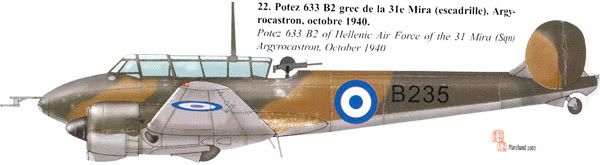
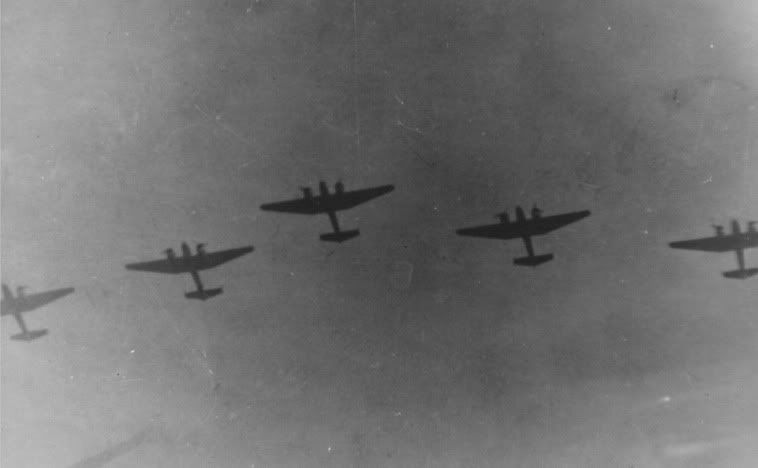
Greek Potez 633In January 1938, the Greeks signed an agreement with the French, for the delivery of 24 twin-engine Potez 633 B2 Grec bombers, with a deadline of one year. 13 aircraft were delivered, one of which was destroyed with French crew on the delivery to the Tanagra Air Base. The remaining 11 were confiscated by the French upon the outbreak of the war. The Greek Potez 633 had bombing configuration, except one that was delivered with photographic equipment. Their equipment included Hydraulic variable-paced propellers, F.R. radio, periscopic Bronzavia type bombing sight, OPL 36 fixed gunner sight, and GPU rails for four or two bombs. They took part in the operations in 1940 - 1941, with the 31st Bombing Squadron, until their final immobilisation due to lack of spare parts.
Operational History
Jan. 1938 - 24 aircraft ordered from France
1939 - Only 12 are delivered, one has been destroyed by the French crew delivering it and 11 have been confiscated by the French due to the outbreak of the war.
1940-1941 - At the beginning of the war, No. 31 Bomber Squadron has eight serviceable Potez 633 B2 and is stationed at Niamata, Larissa. The Squadron’s flying personnel consists of 23 officers and non commissioned officers. The Potez 633 aircraft take part in numerous bombing and reconnaissance operations until they are grounded due to lack of spares, shortly before the arrival of the Germans.

Air Kills
CONFIRMED 22 Nov. 1940 - Chr. Christidis (Potez 633, rear gunner) downs a Fiat fighter over Lake Maliki.

Specifications
Potez 633 B2 Grec

Length: 11.07 m
Height: 3.62 m
Wingspan: 16 m
Wing Area: 32.7 sq. ft
Weight: (max) 4,500 kg, (empty) 2,450 kg
Engines: 2x Gnome Rhone 14 M6/M7 700 hp
Range: 1,300km
Service Ceiling: 8,000 m
Speed: 393 km/h at sea level, 439 km/h at 4200 m Armament: FN-Browning 7,92 mm machine gun, 8 x 60 kg internal bomb payload and 4 x 60 kg external bomb payload or 2 x 220 kg on external rail carriers
Crew: 2


For Gamers and Game designers
Although a relatively modern type, the Potez 633 was too slow and could not carry large bombloads. Its contempary German equivalent was the BF 110 C, which was 100 km/h faster with the same bombload.


For Modellers
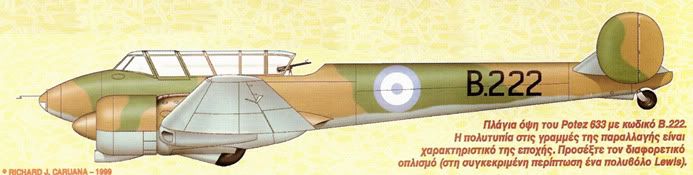
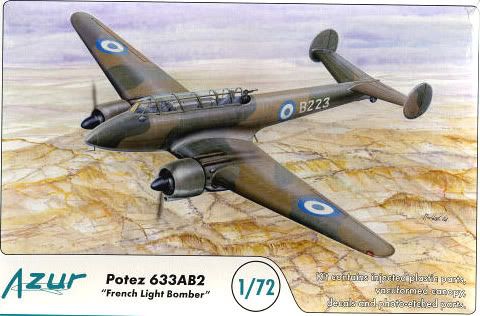
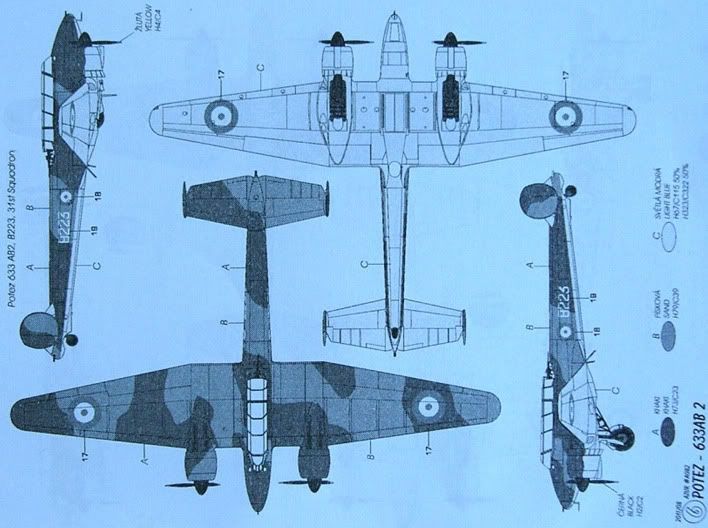
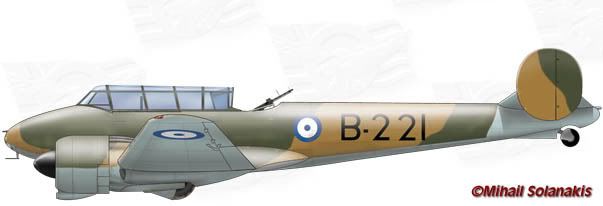
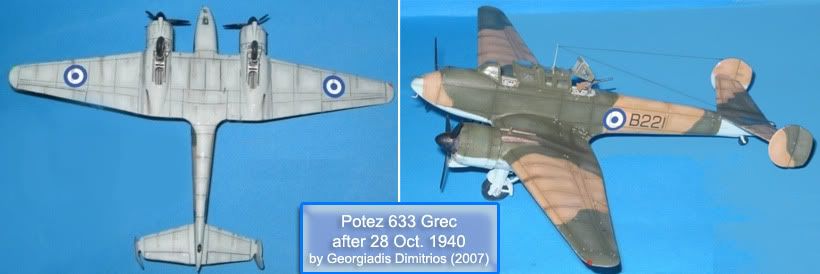
The 12 Greek Potez 633 were the B221-B231, B233 and B234. Originally in natural metal, they were later painted in the typical Greek wartime colours of green-brown-light blue. The following are some models and paintschemes from various sources:

B 221
A profile by Michail Solanakis and a model by Dimitris Georgiadis in wartime colours:


B 222
A profile by Richard Caruana:


B 223
One of the few Greek world war 2 aircraft released as ready-to-build model kit. This one is from Azur in 1/72:
Greek Potez 633 Greek Potez 633

B 235


Additional photos

Sunday, 3 October 2010

(1943-1973) Minesweeper "Paralos"

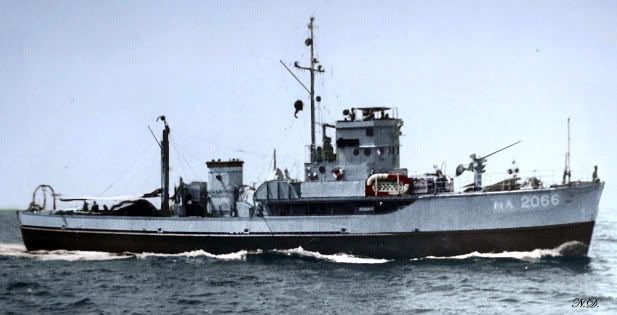
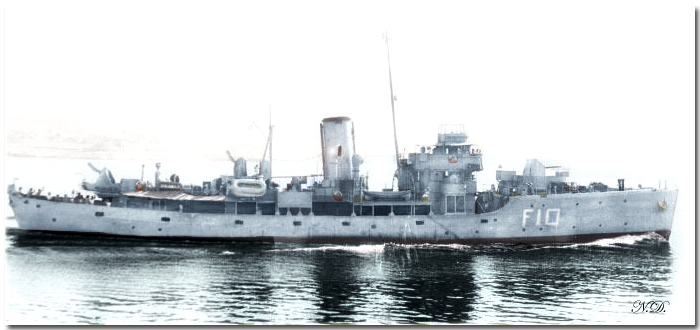
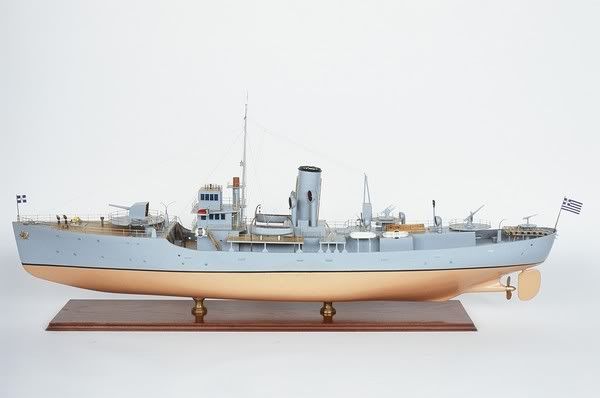
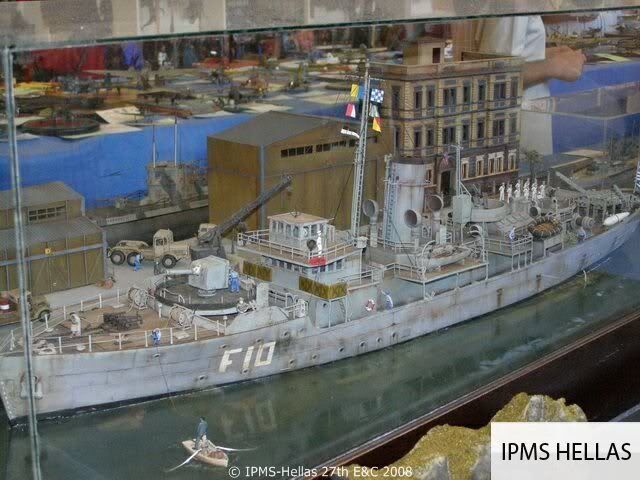
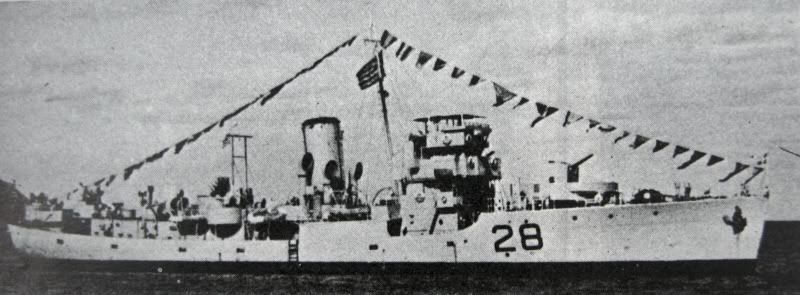
Minesweeper MykonosOne of four BYMS class wooden motor minesweepers that were transfered from the Royal Navy to Greece during World War II. Her sisters were Afroessa, Karteria and Salaminia. The BYMS class minesweepers were built in the US and were originally offered to the Royal Navy as part of the lend-lease programme between 1941 and 1943. They were able to perform magnetic, acoustic and mechanical minesweeping. Paralos did not serve with the Royal Navy at all. It was transfered brand new to the Greek Navy.

Operational History
9 June 1943 - Accepted to the Greek Navy in Grimsby by Lt Cdr Ch. Foufas HN, Squadron Commander of these four minesweepers.
1 Sep. 1943 - Sails to Alexandria. Used in minesweeping operations in the Eastern Mediterranean.
From 1945 - Participates in the post-war large-scale minesweeping of the Greek waters.
11 Sep. 1973 - Decommissioned.


Specifications
MMS class minesweeper "Paralos"

Displacement: 223 tons
Propulsion: Diesel 1,000 hp
Length: 41.45m
Width: 7.5m
Draft: 1.8m
Speed: 12 knots
Armament: 1 × 3 inch/50 gun, 2x 20mm guns, and four machine guns
Crew: 33


For Gamers and Game designers
A relatively modern minesweeper with adequate armament.

Sunday, 12 September 2010

(1939-1941) Destroyer "Vasilefs Georgios"

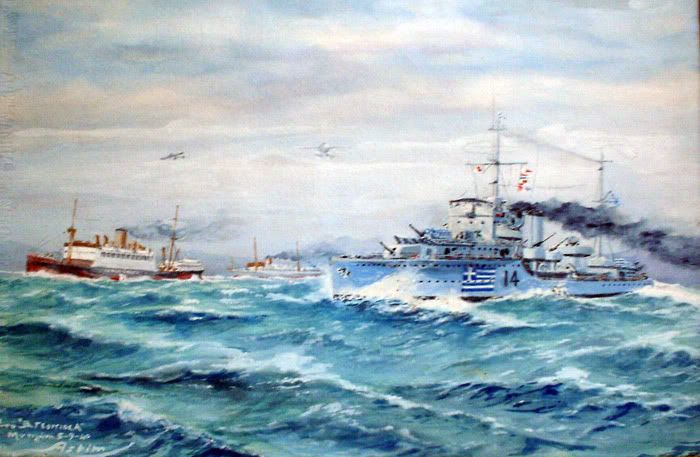
Vasilefs Georgios, 11 Sep. 1940, Gulf Geras - notice Greek flag painted on the sides
The sister ship of Vasilissa Olga, Vasilefs Georgios was also built by Yarrow and fitted with German-made 127mm (5 inch) guns and 37mm AA guns. Two further ships of the same class, the Vasilefs Konstantinos and Vasilissa Sofia, were to be built in Greece, but construction halted due to the outbreak of the Second World War.
Vasilefs Georgios became the flagship of the Greek Destroyer Flotilla.

Operational History
Painting, Vasilefs Georgios in convoy escort duty
As "Vasilefs Georgios"
1937 - Laid down.
3 Mar. 1938 - Launched.
5 Feb. 1939 - Commissioned.
14 - 15 Nov. 1940 - Participates in the first naval raid against Italian shipping in the Strait of Otranto.
4 - 5 Jan. 1941 - Participates in the third naval raid against Items retrieved from Vasilefs GeorgiosItalian shipping in the Strait of Otranto.
14 Apr. 1941 - During the German invasion of Greece, while anchored at Sofikos Bay in the Saronic Gulf, she is attacked by German aircraft and suffers severe damage. Under the command of her captain, Commander P. Lappas, she manages with great difficulty to reach the Salamis Naval Yard where she is dry docked. However, due to the rapid German advance and the inability of repairs to be completed on time, she was scuttled to prevent capture.


As ZG-3 "Hermes"
ZG3 HermesMar. 1942 - Vasilefs Georgios is raised and repaired by the Germans. It is commissioned in the German Navy as ZG-3 "Hermes" on 21 Mar. 1942. ZG3 becomes the flagship of the German Aegean Flotilla, serving mainly in convoy escort duties, under Kapitän zur See Rolf Johannesson.
24-25 Jun. 1942 - Together with the Italian destroyer Turbine and the Italian torpedo boats Castelfidardo, F. Crispi and Solferino, ZG3 escorts a convoy of seven transports from Piraeus to Crete.
26-27 Jun. 1942 - ZG3 and the Italian escorts escort sone ships back from Crete.
02-03 Jul. 1942 - A defensive mine laying operation of the mine layers Barletta and Bulgaria near the Cyclades is covered by ZG3 and the Italian boats Cassiopeia and Lupo.
06-07 Jul. 1942 - ZG3 transfers from Piraeus to Crete.
08-10 Jul. 1942 - Together with three Italian warships and two German submarine chaser, ZG3 escorts a convoy of 7 ships to Tobruk.
15-17 Jul. 1942 - ZG3 and the Italian torpedo boat Cassiopeia escort a small convoy of two ships form Tobruk to Piraeus.
22 Jul. 1942 - ZG3 transfers from Piraeus to the Suda Bight at Crete.
23-24 Jul. 1942 - A small convoy of two transports is escorted by ZG3 and an Italian torpedo boat form Crete to Tobruk.
24-25 Jul. 1942 - The destroyer returns to the Suda Bight.
16 Nov. 1942 - Near Cape Kafireas, one of the convoys escorted by ZG3 comes under attack by the Greek submarine Triton. Triton is sunk by one of the escorting vessels.
1943 - ZG3 leaves the East side of the Mediterranean and operates in the West Mediterranean, escorting supply ships to North Africa.
Apr. - May 1943 - New commander of ZG3 is FKpt. Lampe.
21 Apr. 1943 - ZG3 sinks the British submarine HMS Splendid.
30 Apr. 1943 - During the battle of Tunis, ZG3 is heavily damaged by air attacks and is forced to run aground near Cape Bon in Tunisia a few days later. When the Allies liberate the area it is decided not to repair the ship due to the high cost involved and it is abandoned.

Specifications
Modified G-class destroyer "Vasilefs Georgios"
Displacement: (Standard) 1,414 tons
Length: 97.5 m
Beam: 9.7 m
Draft: 2.7 m
Range: 4,800 nautical miles (8,890 km) at 19 knots (35 km/h)
Speed: 35 knots
Engine: 3 Admiralty 3-Drum Type Boilers, 2 Parsons Geared Turbines, 34,000 HP
Complement: 145
Armament: (original) 4×5 in, 4×37 mm A/A, 2×4 21 in T/T
(German refit) 4×5 in, 4×37 mm A/A, 4×20mm, 2×4 21 in T/T


For modellers
Similar to Vasilissa Olga. Notice that while Greece is a neutral nation (until 28 Oct. 1940), a Greek flag is painted on the sides


For gamers and game designers
A modified G-class destroyer that was as modern as almost any other destroyer at the beginning of the war.

An Italian documentary on the ZG-3 Hermes:

Sunday, 5 September 2010

(1943-1959) Flower class "Apostolis"

Flower class corvette 'Apostolis'A British ship, originally named HMS Hyacinth, with two successes against Italian submarines (one sunk, one captured) and one German submarine sunk (U-617). It was transfered on loan to the Hellenic Navy in 24 October 1943 and was renamed "Apostolis" after the Admiral from Psara that participated in the 1821 War of Independence. With the Greeks, the ship operated in the Mediterranean for the remainder of the war and in the civil war between 1946 and 1949. It war given back to the Royal Navy in 1959.

Operational History
as HMS Hyacinth
1940 - Commissioned in the Royal Navy.
28 September 1941 - Sinks Italian submarine Fisalia near Tel Aviv.
9 July 1942 - Damages and captures Italian submarine Perla. Perla is repaired and is put into operation with the Hellenic Navy under the name Matrosos.
12 September 1943 - HMS Hyacinth and the Australian minesweeper HMAS Wollongong sink the German submarine U-617.
as Apostolis
23 Oct. 1943 - Transfered to the Greeks in Alexandria and renamed "Apostolis".
1946 - 1949 - Participates in the Greek civil war on the side of the National Army.
1959 - Returns to the Royal Navy.

Specifications
Flower class corvette "Apostolis"

Displacement: 1,060/1,250 tons
Propulsion: 2,750 hp
Length: 62.4m
Width: 9.75m
Draft: 4.4m
Speed: 16 knots
Armament: 1 × 3-inch gun, 1 x 40mm, 4 x 20mm
Crew: 85


For Gamers and Game designers
HMS Hyacinth had a remarkable war record, with three anti-submarine successes, but was not equally successful in Greek service as Apostolis.


For Modellers
A model of Apostolis in the Hellenic Maritime Museum:
Model of Apostolis in the Hellenic Maritime Museum

and a model competing at IPMS Hellas 2008:
Model of Apostolis at IPMS Hellas 2008

Notice that contrary to other Flower class corvettes, like Kriezis and Tompazis, Apostolis had never had her forecastle extended. That is because both in British and in Greek service, it operated exclusively in the East Mediterranean, far from British shipyards. Also, she carried a 3-inch instead of a 4-inch gun.

More photos:
Apostolis post-war