Tuesday, 26 April 2011

(1923-1938) Gloster Mars

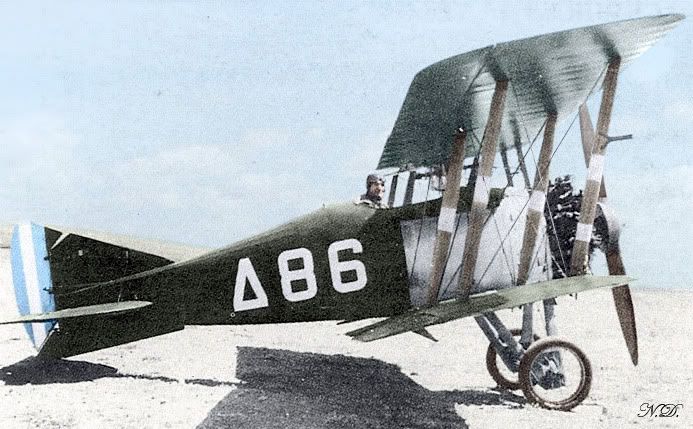
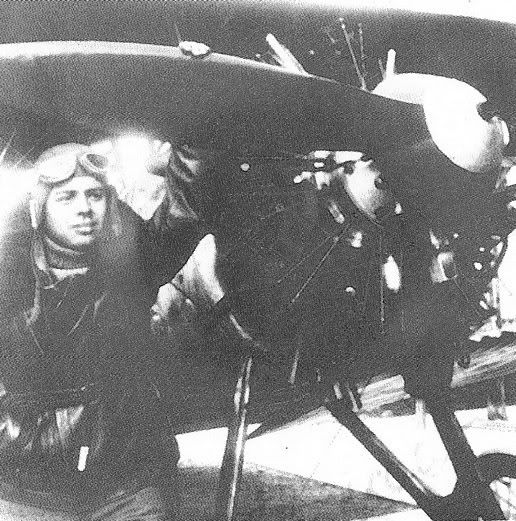
Gloster 'Mars' VI NighthawkIn 1922, to address the serious lack of available interceptor planes during the Asia Minor campaign, a number of Gloster Mars interceptors were ordered from Great Britain. They were delivered shortly after the end of the war and by April 1923 they had already equipped the 5th Fighter Squadron, which was especially created for them.
They were distributed between the Army (Tatoi/Dekeleia) and the Navy (Faliro). The Gloster Mars remained in active service as the only Greek interceptor until 1934, from when on it was used for advanced training by the Air Force Academy in Tatoi.

Operational History
1922 - First batch ordered from Great Britain.
January 1923 - First aircraft arrive in Greece.
April 1923 - They equip the newly formed 5th Fighter Squadron and are used as interceptors. They will remain as the only interceptors in Greek service until 1935.
1925-26 - Venizelos orders 25 aircraft of the VI type as part of a large airforce reorganisation programme. Only 13 will arrive.
1934 - Withdrawn from the interceptor role and are now used as advanced trainers for the next four years.

Specifications
Gloster "Mars" VI Nighthawk

Length: 5.50 m
Height: 2.74 m
Wingspan: 8.54 m
Wing Area: 26 sq. m
Weight: (max) 1,006 kg, (empty) 824 kg
Engine: 1 Armstrong Siddeley Jaguar II (325 hp)
Speed: 241 km/h
Armament: 2 x 7.7mm Vickers MG
Crew: 1


For Gamers and Game designers
The first Greek pilots trying the Gloster Mars aircraft claimed that if they had been received a year earlier, the result of the Asia Minor Campaign would have been different. It is an exaggerated claim, of course, but it illustrates how well-liked they were by the pilots. It is not surprising that the Greeks used them as their sole interceptors for over ten years.

For Modellers
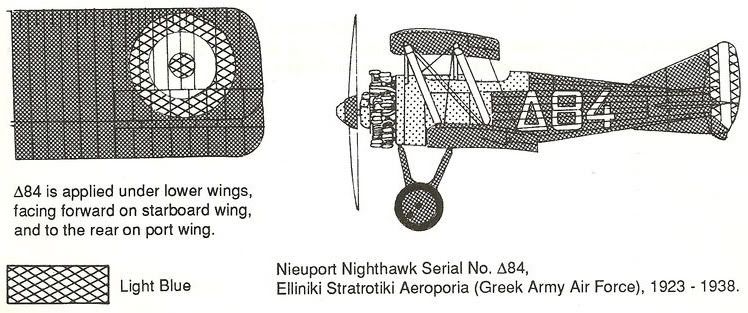
The Gloster Mars aircraft took the serial numbers 1-13.

D84
A Kit from Blue Rider


D94
Destroyed by the Germans. Photo taken April 1941, possibly in SEDES.

Additional photos
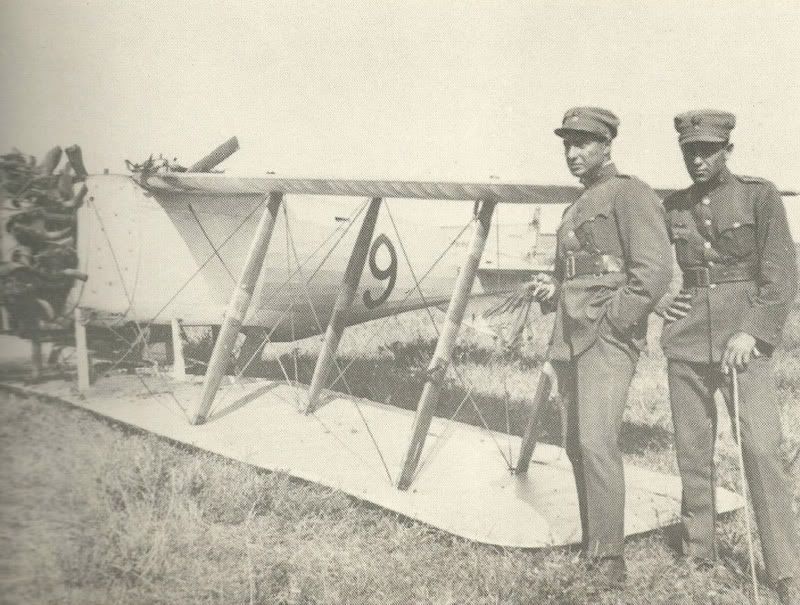
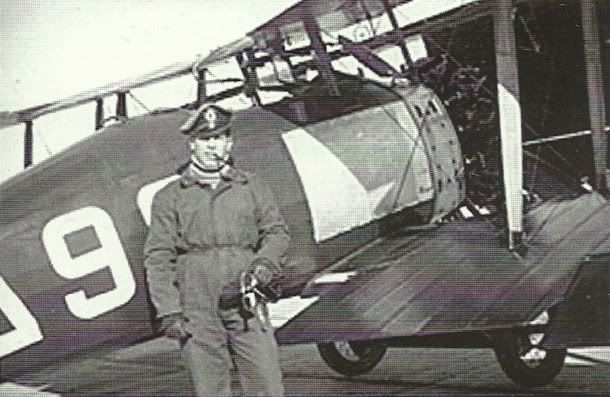
One of the first Gloster Mars delivered. It overturned during landing, Drama airfield. Photos shows Evripidis Skazikis (left) and Xenophon Oikonomou (right) Photo taken late 1930s, when it was used as advanced trainer Photo taken after 1929

Tuesday, 19 April 2011

(1936-1940s) Stokes-Brandt 81mm mortar

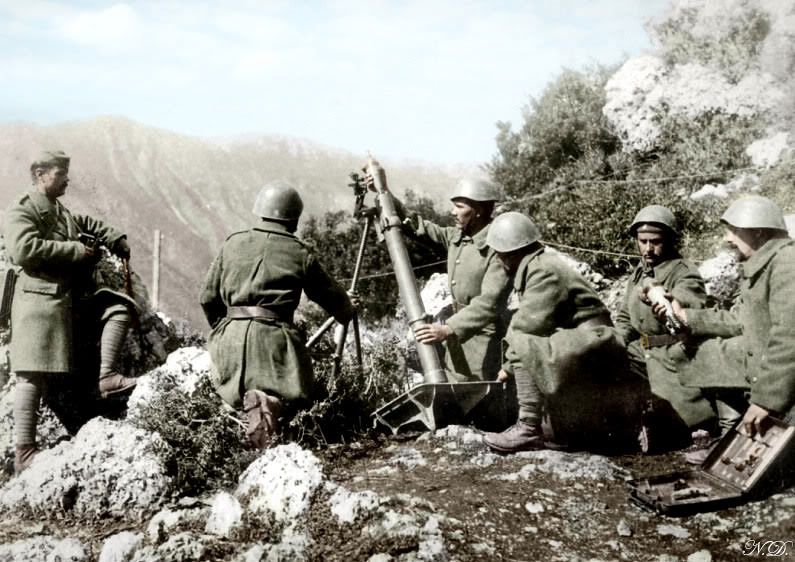
81mm Brandt-Stokes mortar used in the Albanian Front in 1940Following the disaster of the Asia Minor campaign, the Greek army was in disarray, lacking direction and equipment. In 1930, the purchase of mortars was limited to only ten 81mm mortars with 25 shells each. When Metaxas took over in 1936, he launched a large rearmament programme, which included 315 Stokes-Brandt 81mm mortars from France. The well-trained Greek mortarmen made good use of them during the Greco-Italian war.

Operational History

1930 - Greece purchases 10 81mm mortars. The type is unclear.
1936 or later - During Metaxas's premiership, Greece requests a large number of 81mm Stokes-Brandt mortars from France. With their factories fully occupied with their own critical needs for equipment, the French agree on a smaller order of 315 mortars.
28 Oct. 1940 - When Italy invades, Greece has 325 81mm mortars, 6 in every infantry regiment and 4 in every cavalry regiment.
post-war - Realistically, any remaining Stokes-Brandt mortars must have been captured by the Germans in 1941. However, Greece continues using for decades the M1 81mm mortar, which is the U.S. version of the same mortar.

Specifications
81mm Stokes-Brandt mortar M.1927/31

Weight: 56 kg
Barrel Length: 1.26 m
Crew: 3
Caliber: 81mm
Rate of Fire: 18 rounds per minute
Effective Range: 1,000 - 1,900m

For gamers and game designers
General Prasca, who led the initial offensive in the Greco-Italian war, was impressed by the efficiency of the Greek mortars and expressed the opinion that they were using special ammunition. Of course, this was not true.


For modellers
81mm Brandt Mle27 mortar

Monday, 4 April 2011

(1930-1942) Y-6 Glafkos

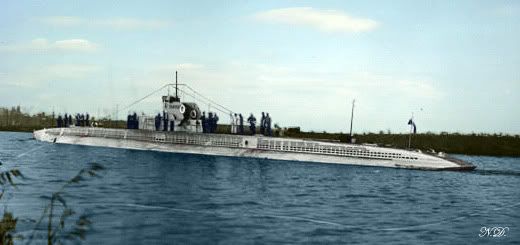
Y-6 Glafkos in the 1930sBeing one of four Loire-Simonot type submarines in the Greek Navy, Glafkos was a sister of Y-3 Proteus and similar to the earlier Katsonis class. Glafkos was undergoing major repairs and did not participate in any patrols during the Greco-Italian war. She escaped to Alexandria and carried two war patrols under Cdr. Arslanoglou. In 1942, she was sunk by German bombers while stationed for repairs in the port of Malta.

Operational History

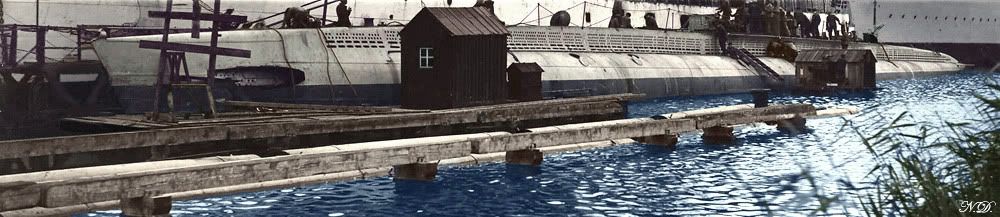
1928 - Launched. It is the only submarine of the class that is built in the Chantiers Navals Francais (Blainville, France). The other three were built in the Chantiers de la Loire.
Y-6 Glafkos being built, July 1928
17 Nov. 1930 - Commissioned.
1 Dec. 1930 - Received by A. Zangas and G. Labrinopoulos
1935 - Damaged during the political upheavals of 1935. It is possibly because of these damages that Glafkos is undergoing repairs and is out of action during the Greco-Italian war.
1940 - The new commander of Glafkos is Vaker.
1941 - The new commander of Glafkos is D. Zeppos.
19-23 Apr. 1941 - Glafkos escapes to Alexandria. New commander is V. Arslanoglou.
12 Jul. 1941 - Begins first wartime patrol in the Dodecannese.
21 Jul. 1941 - Sinks the Italian sailing vessel San Nicola (21 GRT) with gunfire 4 miles NW of Rhodes.
22 Jul. 1941 - Sinks a sailing vessel with gunfire off Castelorizzo.
27 Jul. 1941 - Returns from first patrol after a total of 216 hours submerged and 138 hours surfaced.
5 Nov. 1941 - Begins second wartime patrol north of Crete.
10 Nov. 1941 - On the way to Malta for engine repairs, Glafkos V. Arslanogloutorpedoes and damages the German merchant Norburg (2392 GRT) off Suda Bay, Crete.
19 Nov. 1941 - Due to urgent need for repair, Glafkos arrives in Malta ending the second patrol after a total of 158 hours submerged and 169 hours surfaced.
1 Dec. 1941 - One of Glafkos's crew, Vasilios Merlin, loses his life while in training with British submarine HMS Perseus which sinks off Otranto.
27 Feb. 1942 - V. Arslanoglou and Ioannis Kostakos are the two casualties of a German bombing of the harbour of La Valetta, where Glafkos undergoes repairs. A. Daniolos takes command of the submarine.
4 Apr. 1942 - Sinks by German bombers in the Harbour of La Valetta. No casualties. The crew is transfered to Alexandria aboard Y-3 Proteus.

Map showing the three successes and the location of the sinking of Glafkos

Specifications
Y-6 Glafkos submarine of the Proteus class

Cost: £119,000 each submarine of the class
Displacement: Surfaced 750 tons, Submerged 960 tons
Length: 68.6 m
Beam: 5.73 m
Draft: 4.18 m
Propulsion: 2-shaft Sulzer diesels plus 2 electric motors, 1420bhp/1200shp
Complement: 41
Max. Dive: 80 m
Speed: (Surf.) 14 knots, (Subm.) 9.5 knots
Range: (Surf.) 4,000 nm @ 10 knots, (Subm.) 100 nm @ 5 knots
Fuel: 105 tons of oil
Armament: 100mm gun at the forward end of the conning tower, at casing level (150 shells) and one 40mm. No external tubes. 8x 533mm torpedo tubes (6 bow, 2 stern; 8 torpedoes)


For gamers and game designers
With only two wartime patrols, Glafkos was the least active of the four Proteus-class submarines. In 1941, it was obsolete by the standards of the major powers, but still dangerous with the 8 torpedo tubes.


For modellers

Wednesday, 16 March 2011

(1917-1931) Breguet XIV

Greek Breguet XIV (No3844, I believe). Somewhere in Asia Minor, 1921-22.French built biplane bomber and reconnaissance aircraft that entered French and Greek service in 1917. It equipped the 532 and 533 Squadrons operating in the Macedonian front. It remained in service throughout the 1920s before becoming a trainer for observers in 1931.

Operational History

November 1917 - The Breguet XIV enters Greek Breguet XIV in Smyrna, 1919service, equipping the 532 and 533 Squadrons which operate in the Macedonian front.
22 Dec. 1918 - Commander Denain lends his personal plane to A. Moraitinis, the leader of the Greek Navy Air Service, to fly from Thessaloniki to Phaliron. The plane never arrives to its destination. A month later Moraitinis is declared dead.
21 Sep. 1921 - A Breguet XIV A2 is captured by the Turks and will serve from now on with them. It takes the name "Sakarya".
17 Apr. 1922 - On the third attempt to land, a Greek Bre XIV Breguet XIV A2 captured by the Turkscrashes and burns at Afion Kara Hissar, with one of two crew dead.
22 Aug. 1922 - A second Breguet XIV A2 is forced to land due to enemy fire and is captured by the Turks. It will serve from now on with them and it takes the name "Garipçe". These are the first two Breguets XIV A2 in Turkish service. After the foundation of the Turkish Republic another 16 will be bought from the French and will serve Turkey until 1926.
October 1931 - From now on, 7 Bre XIV aircraft are used for the training of observers.


Specifications
Breguet XIV that reads 'Peloponnisos' and has a bee painted on itBreguet XIV A2 Reconnaissance Length: 8.87 m Height: 3.3 m Wing area: 47.5 m² Wingspan: 12.4 m Weight: 1,010 kg (empty), 1,536 kg (max takeoff) Engine: 1x Renault 12Fe, 224 kW (300 hp) Service Ceiling: 6,000 m Speed: 184 km/h Armament: 1 fixed 0.303-in (7.7-mm) Vickers machine gun on fuselage port side, 2 ring-mounted 0.303-in (7.7-mm) Lewis machine guns in observer’s cockpit, 40 Kg bomb payload. Range: 3 hours Crew: 2


Specifications
Breguet XIV B2 Bomber Length: 8.87 m Height: 3.3 m Wing area: 47.50 m² Wingspan: 14.36 m Weight: 1,010 kg Engine: 1x Renault 12Fe, 224 kW (300 hp) Service Ceiling: 6,000 m Rate of climb: 292 m/s Wing loading: 32 kg/m² Power/mass: 0.14 W/kg (0.09 hp/lb) Speed: 175 km/h Range: 900 km Armament: 1x fixed 7.7 mm (.303 in) Vickers machine gun, 2x flexible 7.7 mm (.303 in) Lewis Gun for observer, 300 Kg bomb payload. Crew: 2


For Gamers and Game designers
Apart from its widespread usage, it was noteworthy for becoming the first aircraft in mass production to use large amounts of metal rather than wood in its structure. This allowed the airframe to be lighter than a wooden airframe of the same strength, in turn making the aircraft very fast and agile for its size, able to outrun many of the fighters of the day. Its strong construction was able to sustain much damage, it was easy to handle and had good performance. The Breguet 14 is considered one of the best aircraft of World War I.

For Modellers
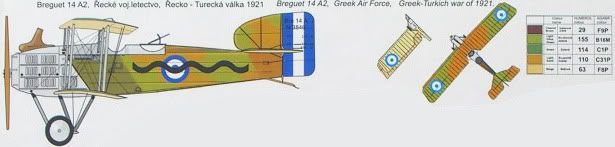
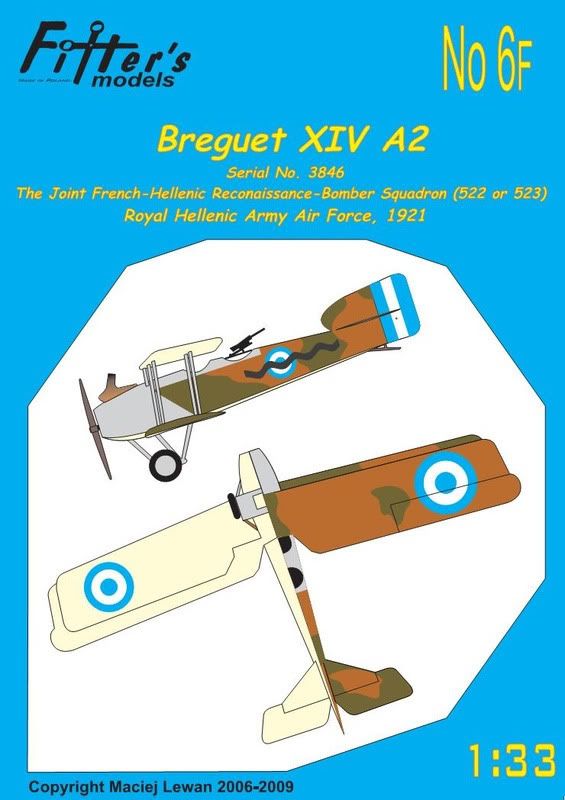
A profile of the No3846 Breguet XIV A2 that fought in Asia Minor in 1921, taken from Issue No. 15 of Insignia Magazine: 1:33 Paper model by Fitter's Models The text is from the Insignia Magazine: "This aircraft was one of at least 30 Breguet 14 A2 and B2 types which served with the joint French-Hellenic 522 and 523 Reconnaissance-Bomber Squadrons. Finished in a Green and Brown camouflage scheme, with Natural Metal forward and upper fuselage areas. Lower flying surfaces are Clear Doped Linen. Struts, undercarriage legs and wheel covers are Light Grey. Greek roundels in Blue and White, adapted from French roundels, are worn on the upper and lower wings as well as the fuselage. The Asia-Minor 'wavy line' theatre marking in Dark Grey/Black partially obscures the fuselage roundel. Serial number and rudder data are Black."

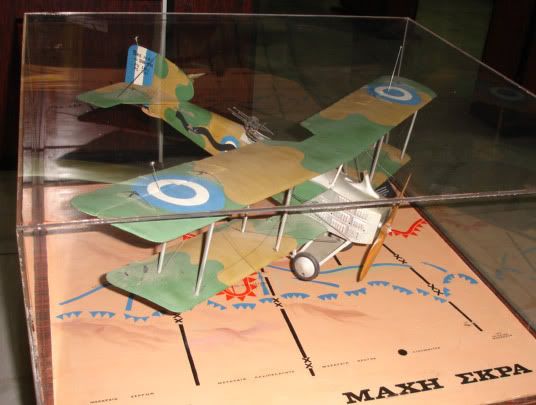
A model exhibited in the National War Museum, Athens.
A model exhibited in the National War Museum, Athens

A Breguet XIV A2 from AZ Models (seems to be No3844):
AZ Models: Greek Breguet XIV A2 AZ Models: Greek Breguet XIV A2
A 1:33 paper model by Fitter's Models:
1:33 Paper model by Fitter's Models
A Microsoft Flight Simulator model by Manuele Villa:
A Microsoft Flight Simulator model by Manuele Villa

Thursday, 10 March 2011

(1919-1941) Torpedo Boat "Proussa"

Torpedo Boat Proussa

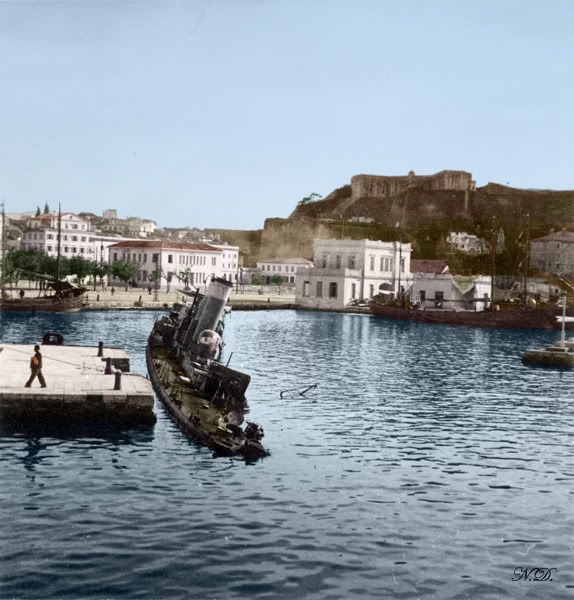
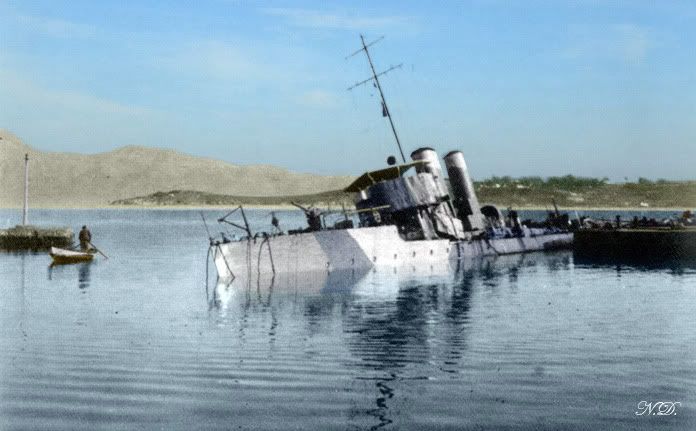
Formerly the Austrohungarian Fiume-class torpedo boat SMS Tb 94 F., Proussa, together with her two sister ships "Panormos" and "Pergamos", was transferred to Greece in 1919 as war reparation from the Central Powers. Little is known about Proussa in Greek service other than that she was sunk in Corfu during the 4 April 1941 Italian bombing of the port. She stayed half-sunk for quite a while. Later, when the Italians were in control of the island, they wrote "V" (for "Vinceremo" - we will win) on one of the funnels. According to one version of the story, the Italians tried to raise the ship, but she sank while being towed.

Operational History
In Austro-Hungarian Service
30 Nov. 1914 - Laid down at the Ganz & Co.- Danubius shipyard.
1915 - Commissioned. Serves the Austro-Hungarian Empire until the end of World War I.

In Greek Service
1919 - Transfered to Greece as war reparations.
3 April 1941 - Sails from Patra during the evening. Captain: N. Kotsilyris.
4 April 1941 - Arrives early morning at Agioi Saranta for Rear Admiral D. Economou to inspect the naval command there. For a few hours, she stays by the coast to avoid detection by enemy aircraft. Around noon, she sails towards Corfu where she arrives at 14:10 for D. Economou to inspect the naval command there and find out how the minesweepers Strymon and Aliakmon were damaged a few days earlier. Proussa stays 100 m from the dock (between Kafe Gyali and Vido). The Rear Admiral disembarks, but before his boat reaches land, Proussa is attacked by nine (or 6 according to some sources) Italian Ju-87 Pichiatelli belonging to the 239th Sqn, 97th Dive-bombing group (Captain Mario Larket) from Galatina, near Lecce. Evasion manoeuvres are attempted, but the ship's engines are damaged by the near misses of the Pichiatelli that were dive bombing. The AA gun managed to fire only 7 rounds. The Pichiatelli dropped five 500kg bombs at distances of 5 to 100m from the Torpedo boat Proussa sunk
ship. After the attack finishes, the Greeks pull the ship with ropes to the dock. The fire service, the auxiliary "Evangelistria" and several civilians try to save the ship until 11 o'clock, but unsuccessfully. Proussa settles at a depth of 4 m at the Kafe Gyali dock.
During the attack, the crew is said to have managed to disarm the torpedoes on Proussa to Torpedo boat Proussa sunkreduce the chance of catastrophic damage from a bomb hit. 8 crew are wounded, but nobody is killed.
This is one of three attacks carried out by this air group against Greek naval vessels this day, including the 932-ton cargo ship "Souzana" that was skip-bombed and sunk during the morning.


Specifications
Fiume class Torpedo Boat "Proussa"

Displacement: 243 tons (standard)
Propulsion: 2 Yarrow water-tube boilers, 2 AEG-Curtis steam turbines, 2 shafts. 5,000 / 6,000 shp
Length: 57.76 m
Width: 5.8 m
Draft: 1.5 m
Speed: 31 knots (initially), 32 knots (after 1925) [other sources have it at 28 knots]
Armament: 2x Skoda 70 mm / 30-cal guns, 1x 8 mm AA machine gun (added in 1914), 3x or 4x 450 mm torpedo tubes (2x2).
Crew: 41


For Gamers and Game designers
While in 1919 she was a relatively modern torpedo boat, by World War II, Proussa was completely outclassed by her Italian counterparts. However, she was not slow and if undetected she could still use her torpedoes.


For Modellers
A profile of the Fiume class torpedo boats from an unknown source:
Profile of Fiume Class

Saturday, 5 March 2011

(1881-1919) Steam Gunboat "Aktion"

Steam Gunboat Aktion in 1896 by Körner & Dietrich

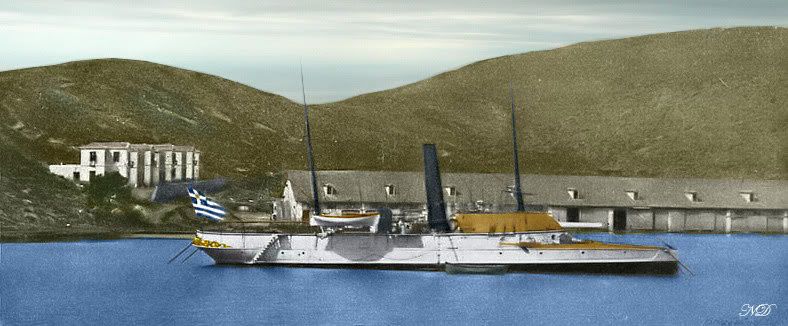
Built specifically for the shallow waters of the Amvrakikos Gulf, Aktion and her sister "Amvrakia" saw action in the gulf during the 1897 and Balkan Wars. Aktion was called Spetses until 1889 when the Greeks decided to use the name for the newer Battleship they had ordered.

Operational History
1881 - Built by Blackwall Dockyards in the UK and named "Spetses".
1889 - Renamed "Aktion".
1897 - Commanded by Lt Cdr E. Tombazis, she sees action against the Turks.
1912-1913 - Commanded by Lt Cdr E. Lambadarios, she sees action against the Turks.
World War I - Used for the service of the Piraeus and Keratsini net barrage.
1919 - Decommissioned after the end of World War I.


Specifications
Steam Gunboat "Aktion"

Displacement: 433 tons
Propulsion: 380hp steam engine
Length: 39m
Width: 7.6m
Draft: 2.9m
Speed: 11 knots
Armament: (initially) 1x270mm/30cal Krupp gun, (later) 1x 6inch gun and a small quick-firing gun.


For Gamers and Game designers
A gunboat that was designed for shallow waters. Despite its massive size, her initial 270mm gun was of little use against distant targets, as one needed to turn the whole ship to aim the gun.


For Modellers
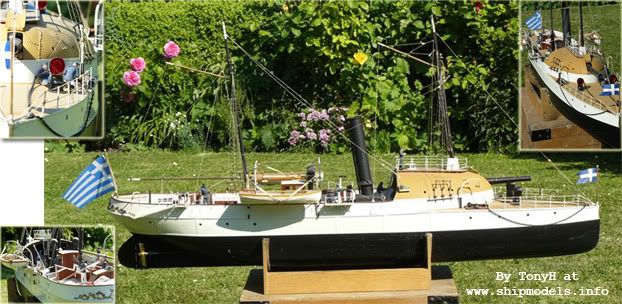
A model of Amvrakia, Aktion's sistership, at the Hellenic Maritime Museum, Piraeus:
Model of Amvrakia at the Hellenic Maritime Museum, Piraeus

A model of Amvrakia, Aktion's sistership, by TonyH of www.shipmodels.info:
Scratchbuild R/C Model of Amvrakia by TonyH at www.shipmodels.info

Thursday, 3 March 2011

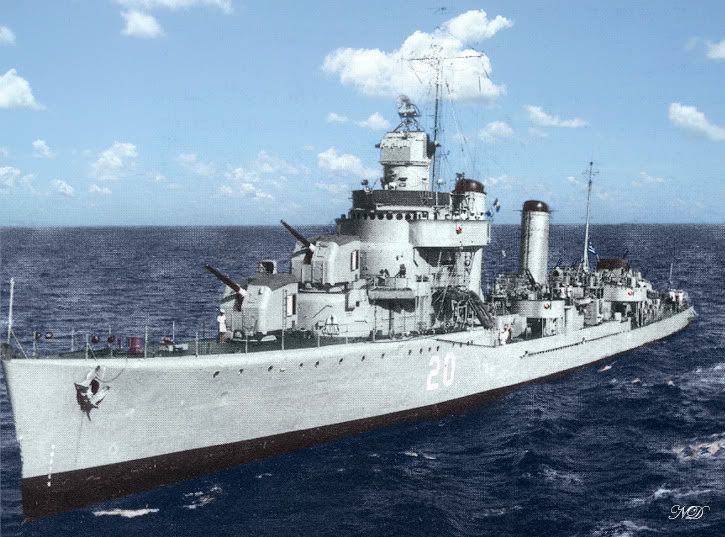
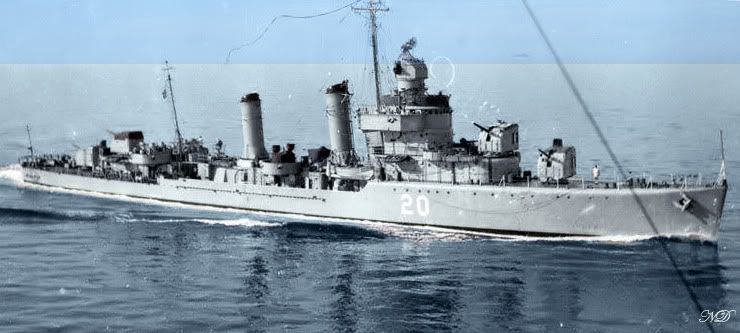
(1950-1971) Destroyer Doxa D-20

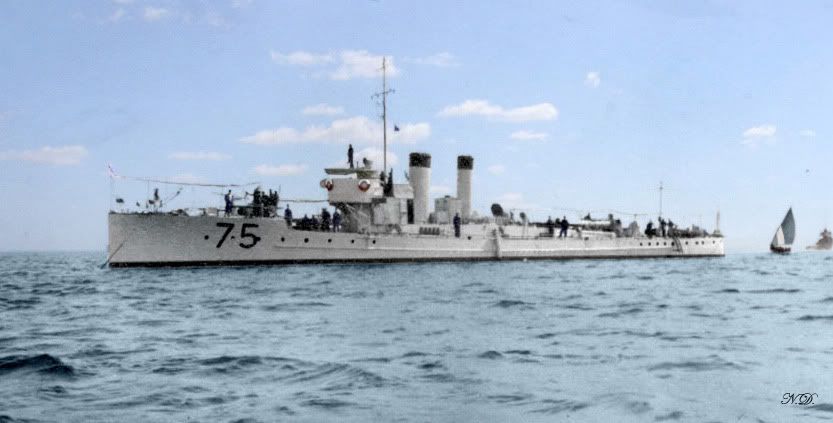
Destroyer Doxa D-20 (probably in the 1960s)Ex-USS Ludlow (DD-438) and one of two similar destroyers offered by the United States, Doxa was accepted in 1950 by Cdr N.Ritsos HN and arrived in Greece in the summer of 1951. She remained in commission without interruption until 1971, when she was put on reserve. The ship's history in US service is quite rich, as she received six battle stars for her World War II service, but less interesting post-war and after she joined the Greek Navy.

Operational History
In US service as USS Ludlow (DD-438):
18 Dec. 1939 - Laid down.
11 Nov. 1940 - Launched.
5 March 1941 - Commissioned.
Oct. 1941 - Having completed shakedown, Ludlow leaves Boston for Newfoundland and Iceland, convoying supplies ultimately destined for the British Isles.
7 Dec. 1941 - Following the attack on Pearl Harbor and the declaration of war between Germany and the United States, Ludlow's convoy runs are lengthened to include the ports of Derry, Liverpool, Greenoch, and Freetown, South Africa.
7 Nov. 1942 - Assigned to Task Force 34 for the invasion of North Africa, Ludlow arrives off Cape Fedhala, French Morocco. Shortly after the first wave of landing craft headed tor shore, Ludlow finds herself engaging shore batteries, bombers, and a Vichy French naval force comprising a cruiser and two destroyers in the Naval Battle of Casablanca. A 6 inch shell strikes her forward and straddling shots are falling close aboard when Augusta and Brooklyn arrive and help to dispose of the French ships.
Jan. 1943 - Returns to New York to repair battle damage and then conducts training off the coast of Maine.
14 Jan. 1943 - Departs for the first of three convoy runs to Casablanca.
June 1943 - After the third convoy, Ludlow remains in the Mediterranean Sea for the forthcoming invasion of Sicily.
10 July 1943 - Ludlow provides fire support for the invading forces off Licata and Porsa Empedocle.
11 Aug. 1943 - Following daily enemy air attacks, Ludlow downs her first enemy airplane.
9 Sep. 1943 - Participating in the invasion of Italy, Ludlow leads a section of the assault wave through a known minefield to the bloody landing at Salerno. She and her sister ships are warmly commended by the commanding general ashore for their effective close range fire support.
Late 1943 until 11 Jan. 1944 - On convoy duty between Naples and Oran.
22 Jan. 1944 - She covers Allied troops storming ashore at Anzio. In the following days, Ludlow splashes two bombers, one fighter and three rocket glider bombs. A 5 inch shell crashes through the torpedo director deck and the pilothouse, causing Ludlow to retire, but serious damage is averted when Chief Gunners Mate James D. Johnson locate the hot, unexploded shell and manage to get it topside and overboard.
Early 1944 - Repaired at New York. Trained along the Atlantic coast.
20 Apr. 1944 - Returned to the Mediterranean for antisubmarine patrols.
19 May 1944 - Ludlow and Niblack depth charge U-960 to the surface, where Ludlow's main battery sinks her.
11 Aug. 1944 - Following convoy alignments in the western Mediterranean, Ludlow steams from Palermo for the invasion of southern France. 25-30 Aug. 1944 - Following preinvasion bombardment and beachhead screening off Frejus, she joins Augusta (CA-31) to help overcome the last resistance at Marseilles. While on coastal fire support missions around Monaco, she encounters not only floating mines and E-boats, but also attacks by explosive-laden boats and human torpedoes.
5 Sep. 1944 - Ludlow captures three operators of these one-man diving machines after a series of depth charge attacks. Fire support, convoy and patrol duty continue.
23 Jan. 1945 - Ludlow sails for a month's plane guard duty off the west coast of Africa.
28 Feb. 1945 - Returns to Boston.
Apr. 1945 - Ludlow sails to England to escort a convoy of LSTs stateside and then prepares for duty in the Pacific.
27 June 1945 - Crosses the Panama Canal
17 July 1945 - Reaches Pearl Harbor and begins training for operations with the fast carriers. The surrender of Japan, however diverts her to the job of escorting ships filled with occupation troops to the home islands of the defeated Empire.
7 Sep. 1945 - Departs Pearl Harbor
27 Sep. 1945 - Arrives at Wakayama, Japan, and operates in the Far East.
3 Nov. 1945 - Sails for the Aleutians where she sees a brief period of "Magic Carpet" duty. That is the the post-World War II effort by the War Shipping Administration to repatriate the American military personnel.
20 May 1946 - Out of commission in reserve at Charleston, South Carolina. Utilised for reserve training.
6 June 1950 - In commission in reserve on 6 June 1950
21 Nov. 1950 - On active status.
22 Jan. 1951 - Decommissioned


In Greek service as Doxa D-20:
1950 - Accepted by Cdr N.Ritsos
Summer of 1951 - Arrives in Greece
1954 - Overhauled together with sistership Niki in the United States
1972 - Decommissioned


Specifications
Destroyer Doxa D-20Gleeves class (sub-class Livermore) destroyer "Doxa" D-20

Displacement: 1,639/2,572t
Propulsion: Steam turbines 50.000 shp, twin propeller Length: 106m
Width: 11m
Draft: 5.5m
Speed: 37 knots
Armament: 4x 5inch/38 guns, 12(2x4 + 2x2)x 40 mm guns, 6x 20 mm guns, 5x 21in torpedo tubes,Hedgehog, depth charges.


For Gamers and Game designers
A very capable destroyer during World War 2, but relatively obsolescent by the 1950s.

Friday, 11 February 2011

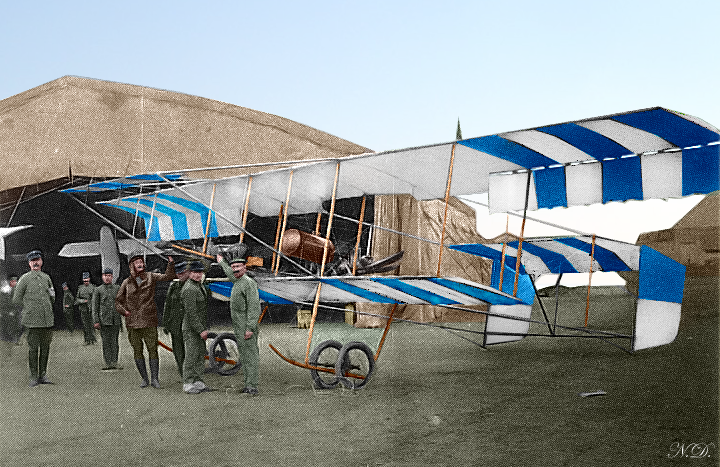
(1912-1915) Henri Farman Biplane

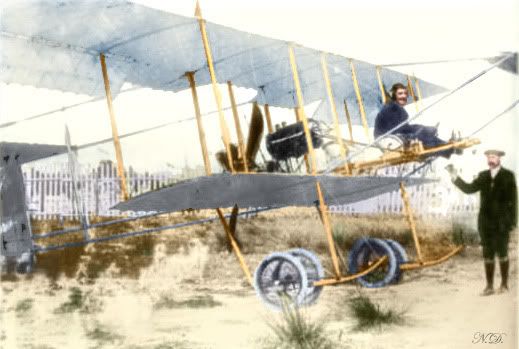
Farman biplane (1912, Larisa). The pilot is probably KamperosIn 1912, with the help of French experts Greece received its first four aircraft to form an air force. They were French-built Farman biplanes; a Henri Farman Biplane named "Daedalus", a Henri Farman 20, a Maurice Farman Hydravion and a Maurice Farman Biplane. Prime minister Eleftherios Venizelos had stated earlier that year that "... the airplane is the weapon suitable for the weaker countries. The venturesome nature of the Greek will make it a brilliant weapon and in the future will do yeoman's service to the Greek Armed Forces...". The purchase of the four aircraft had been financed substantially by the donation of a poet named Matsoukis.

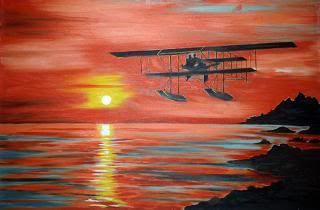
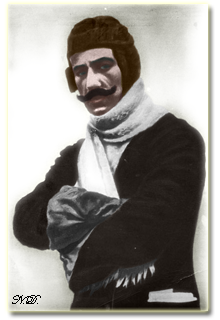
A painting of hydroplane Daedalus in flightOne of the first Greek pilots was Dimitrios Kamperos, an artillery officer. In June 1912, he converted his Henri Farman to a hydroplane and reached a speed of 110 km/h, setting a new world record. After World War I, he served briefly as chief instructor of the Hellenic Air Force Academy ("Icarus School"). He died of cold and starvation during the great famine of 1942.
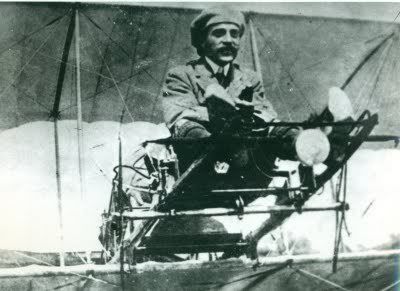
Greek aviator Dimitrios KamperosThe nickname Trelokamperos (Crazy Kamperos) that he earned for his daredevil flying lives on in the Greek language today.

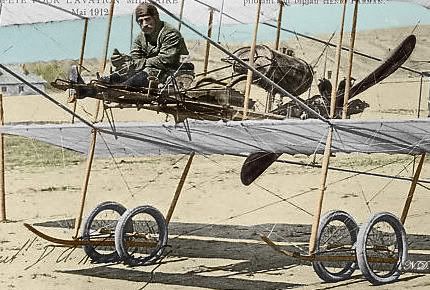
The French carte postale below shows Kamperos ("Campères" in French). It reads: "Henri Farman biplane piloted by Lieutenant Kamperos of the Hellenic Army has landed at Champagne the 1st of May 1912".

French carte postale showing Kamperos in France on 1 May 1912

Operational History
December 1911 - Chosen from a list of 60 applicants, the first Greek officers to be trained as pilots are Dimitrios Kamperos (1st Lt., Artillery), Michalis Moutousis (1st Lt. Engineers) and Christos Adamidis (2nd Lt., Cavalry). The training is held at the flight school of the Farman brothers in Etampes, France.
April 1912 - Three more are added; Loukas Papaloukas (1st Lt., Infantry), Markos Drakos (1st Lt., Artillery), Panoutsos Notaras (2nd Lt., Cavalry).
Farman biplane (1912, piloted by Kamperos, Athens Zoo)9 April 1912 - The first four aircraft arrive at the port of Piraeus inside wooden boxes.
Early May 1912 - Having graduated, Dimitris Kamperos arrives to Greece together with his French mechanic, A. Chauveau. The aircraft are assembled inside the Zoo of Paleo Faliro.
Farman biplane (May 1912, piloted by Kamperos)13 May 1912 - Kamperos takes off and flies for a few minutes. This is the first military flight in Greece. Note that Emmanouil Argyropoulos has already performed the first civilian flight in front of thousands of spectators on 8 February 1912.
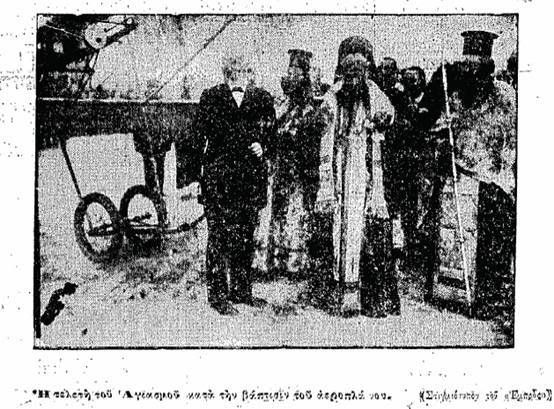
Christening ceremony, 27 May 1912 at the Zoo of Paleo Faliro27 May 1912 - Official ceremony and christening of the aircraft by Venizelos, as "Daedalus", "Aetos", "Gyps", "Ierax". A large crowd has gathered to see them.
June 1912 - Having converted his Henri Farman to a hydroplane, Kamperos breaks the airspeed world record, reaching 110 km/h.
September 1912 - All trainees are called back from Etampes to Greece, to participate in the first Balkan war against the Ottoman Empire.
5 October 1912 - In the first ever Greek air operation, Kamperos takes off from the new Larisa Aerodrome, flies over the borders at the area of "Skompia" and returns to report on the enemy's position.
Kamperos on his Farman biplane.17 October 1912 - Prince Constantine sends a telegraph asking Kamperos to perform reconnaissance flights over the enemy positions in Kozani. On a forced landing near Kozani due to mechanical failure, both Kamperos and Chauveau are injured.


Specifications
Henri Farman Biplane "Daedalus"

Crew: 1
Length: 12 m (39 ft 4½ in)
Wingspan: 10 m (33 ft 9¾ in)
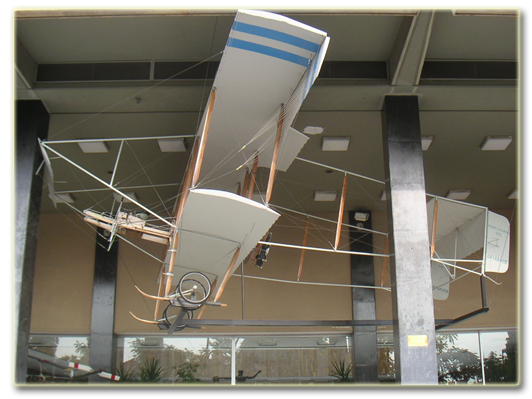
Height: 3.5 m (11 ft 6 in)Farman biplane Daedalus (replica, National War Museum, Athens)
Wing area: 40 m² (430.56 ft²)
Gross weight: 550 kg (1213 lb)
Powerplant: 1 × Gnome et Rhône 7-cylinder rotary engine, 37 kW (50 hp)
Max. Speed: 60 km/h

For Gamers and Game designers
The Henri Farman aircraft could realistically be used only for reconnaissance.

For Modellers
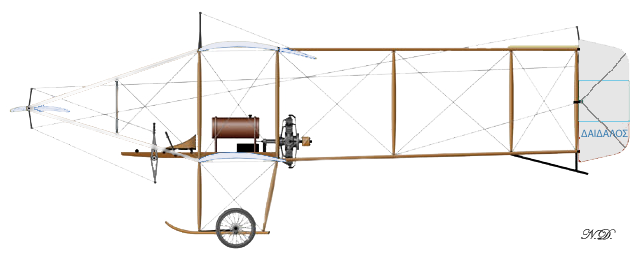
The profile below is based on the replica Daedalus at the entrance of the National War Museum in Athens.

Henri Farman III profile

Saturday, 5 February 2011

(1826-1840) Paddle Steamer Karteria

KarteriaBuilt in London for the Greeks, Karteria was possibly the most modern warship in the world when it entered service in 1826. She was ordered, part financed and captained by retired Royal Navy officer, Captain Frank Abney Hastings.

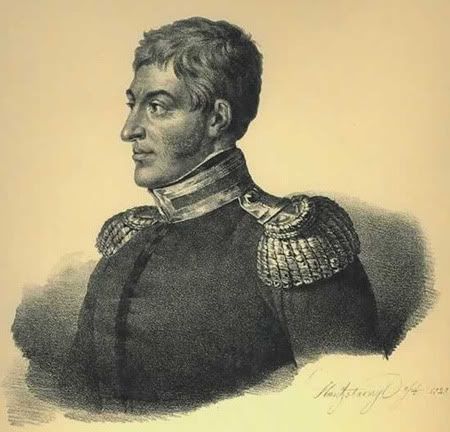
At the age of 11, Hastings had taken part at the Battle of Trafalgar on HMS Neptune. He rose to commander until 1820 when due to an incident with a senior officer he was Hastingscompelled to leave the service. A great philhellene, in 1822 he went to Greece to serve on Tombazis’s ship "Themistoklis". In 1824, he managed to secure £10,000 of the £2,000,000 of the second Greek loan from England, to finance Karteria; he paid for her guns himself. A year later, he was appointed commander-in-chief of the Greek revolutionary navy.

Karteria was classified as a four-masted sloop-of-war that operated under sail while travelling, but could be propelled by steam-powered paddles in battle. Captained by Hastings, armed with 68-pounder guns and equipped with on-board furnaces to provide red-hot incendiary shots, Karteria was deadly against the older wood and sail ships of the Ottoman navy. In 1827 alone, she fired 18,000 rounds and sank several enemy ships.

Karteria is most notable for being the first steam warship in the world to be used in battle (the first steam warship built was the American USS Demologos from 1814). Apart from Karteria, five more steam warships were ordered. Two of them, "Epiheirisis" and "Ermis" entered Greek service before the war was over, one blew up during trials and two were never completed and were left to rot on the Thames.

Hastings is buried in Poros and his heart is immured at the Anglican church of St. Paul in Athens.

Maurice Abney-Hastings, antecedent of Hastings, provides an excellent relevant article by Dimitri G. Capaitzis in his website (www.captainfrank.co.uk). The two quotes below are taken from there:
____________
Materials used for construction are described by Hastings, in his Memoir of 1828:

The ‘Karteria’ was built with her timbers close and caulked together, and would therefore, have floated without planking. I had several opportunities of remarking the advantage of building thus, to resist shot; nothing less than a eighteen pounder ever came through us; this, ’tis true, might be partly attributed to Turkish bad powder, but those shot that did come through, always made a nice clean round hole without a splinter. However, against shells it would have a disadvantage, as they would be more likely to stick in it. Perhaps if shells became generally used, it will be proper to make the upper works of a ship as slight as is consistent with strength, and iron ribs might perhaps be good. The ‘Karteria’ had another peculiarity in her build – two solid bulkheads enclosing the engine room, and caulked and lined, so as to be water tight, the intention of this was, in the event of one part of the ship being leaky from any cause whatever, the water could not flow into another part of the ship. This arrangement, which is due to the ingenuity of Mr Brent, the builder, once saved this ship from fire, which broke out with great force in the after-part of the engine room, and would have communicated to the shell room very quickly. But for this bulkhead, which kept the fire forward, and gave us time to subdue it. I see no reason why all men of war should not be furnished with similar partitions. The same builder saved another ship (the Rising Star) from sinking, by this contrivance.

Samuel Gridley Howe, the ‘Karteria’ American doctor had recorded in his November, 1826 journal:

We have two Englishmen (officers), one German, one Frenchman, and one Greek; The Greek is the eldest son of Tombazi, Captain Hastings is a man who deserves the deepest gratitude and respect from the Greek nation. It is only through his exertion, his activity, and generosity, that this ship was ever got out. She was built under his own eye in London, and carries as much weight of metal as a thirty-six gun frigate; her engine, however, is not the best. Captain Hastings, having on board about forty English and forty Greek sailors, is all ready to join the Greek fleet and engage the enemy.
__________________


Operational History
1825 - Laid down at Daniel Brent's Greenland South Dockyard, Rotherhithe, London, for the Revolutionary Greek navy. The order was financed by the London Philhellenic Committee.
KarteriaMay 1826 - Completed.
September 1826 - Reaches Nafplion.
January 1827 - Sails to Phaliron and sees action in both sea and land engagements. She is accompanied by three brigs and five gunboats.
February 1827 - Sails to Oropos and attacks enemy coastal defences and ships, together with Papanikolis' "Nelson" and Miaoulis' frigate "Hellas". Two transports loaded with equipment and supplies are captured and taken to Poros.
March 1827 - Cochrane takes over as commander of the Greek navy and orders Karteria to lead operations off Volos, together with schooner "Themistoklis", brigs "Aris" and "Panagia" and sloop "Aspasia". Shore defences are destroyed, five loaded transports are captured, two are destroyed and one runs aground. At nearby Trikeri they attack a large warship and four beached captured schooners. All are destroyed by firing from a distance.
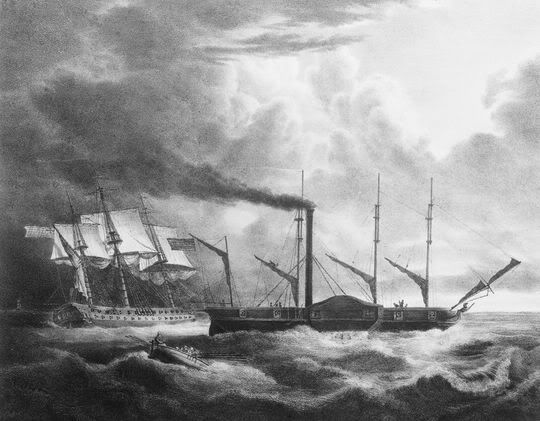
Karteria in front of frigate Hellas, from the National Maritime Museum Greenwich, by Karl KrazeisenSeptember 1827 - Karteria, Hellas, two schooners, twelve brig and three gunships proceed to Vasiladhi and Mesolonghi to take part in the Greek land offensive. They have limited success and the fleet is split.
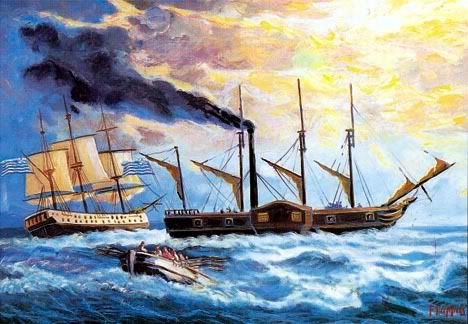
29-30 September 1827 - Hastings with "Karteria", "Sauveur" and gunboats "Bavarois" and "Philhelleic" pass into A remake of the original painting, in colour, by unknown artistthe Gulf of Corinth and enter the Gulf of Salona, to engage one Algereen brig of 14 guns, the enemy Admiral’s 16-gun brig, three small schooners, two armed transport brigs, two large boats with guns, shore batteries and three loaded Austrian transport ships. The Admiral’s brig is set on fire, as well as one schooner and one transport brig, while the Algereen brig is abandoned. Out the nine enemy ships only two are spared. The three Austrian ships are taken as prizes. This success provokes Ibrahim Pasha Karteria on a stampinto the aggressive movements that would lead to his fleet's complete destruction by allied fleet of England, France and Russia at the Battle of Navarino (20 October 1827).
25 May 1828 - Hastings is wounded in an attack at Aetoliko.
1 June 1828 - Hastings succumbs to his wounds in the Harbour of Zante. He is given a state funeral with full military honours and hailed as a great hero by the leaders of the soon to be born Greek State.
February 1830 - Following last September's Treaty of Adrianople, Britain, France and Russia recognise a free Greek State.
16 July 1831 - During one of the first civil conflicts of the new state, where the Hydriots revolt against the State, Karteria is used by the Hydriots to take position west of Galatas, Poros.
27 July 1831 - Together with Hellas, Karteria engages two Russian ships that support the Greek State.
1 August 1831 - Miaoulis sets fire on his fleet at Poros, including the frigate Hellas. Karteria and old two-masted "Emmanouil" are saved by Myconian sailor George Galasidis and another soldier, who swam to the ships and managed to cut the fuses just in time.
1841 - Karteria is officially no longer mentioned in the Greek navy's lists, although it is practically out of commission for almost a decade.

Specifications
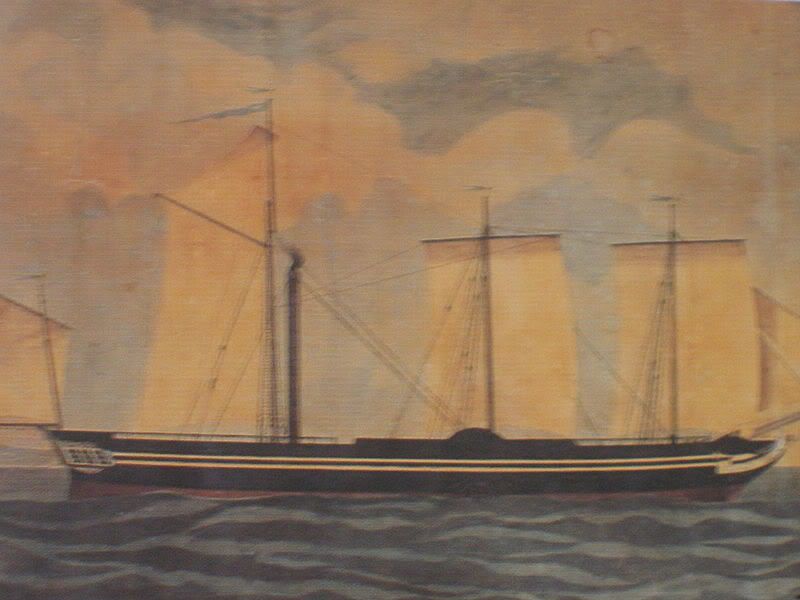
Watercolour of KarteriaPaddle Steamer "Karteria"

Displacement: 233 tons
Propulsion: two steam enginers of 85hp and four masts with schooner rigging
Consumption: 7 tons of coal per day
Speed: 7 knots
Length: 38.4m
Width: 7.6m
Armament: 4 x 68-pounder carronades and 4 x 68-pounder guns of a new design based on a model by Frank Hastings
Crew: 185 (17 officers, 22 petty officers, 32 gunners, 110 sailors and 4 cooks-cabin boys)

For Gamers and Game designers
Being the first steam warship to see action and able to fire red-hot incendiary shots from its 68-pounder guns, Karteria offered a spectacular advantage against the Ottoman navy (and possibly any other navy at the time). Also notice that she travelled under sail and the steam engines were used only in battle.

For Modellers
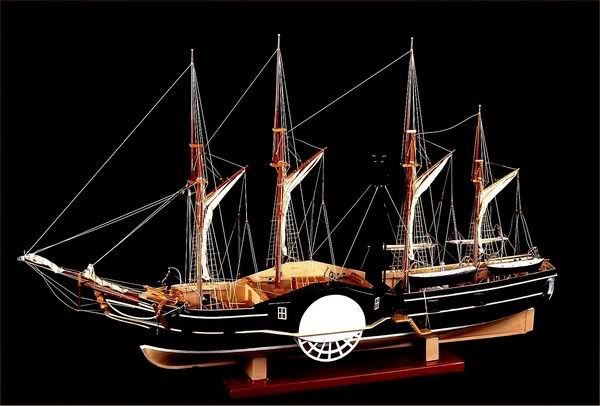
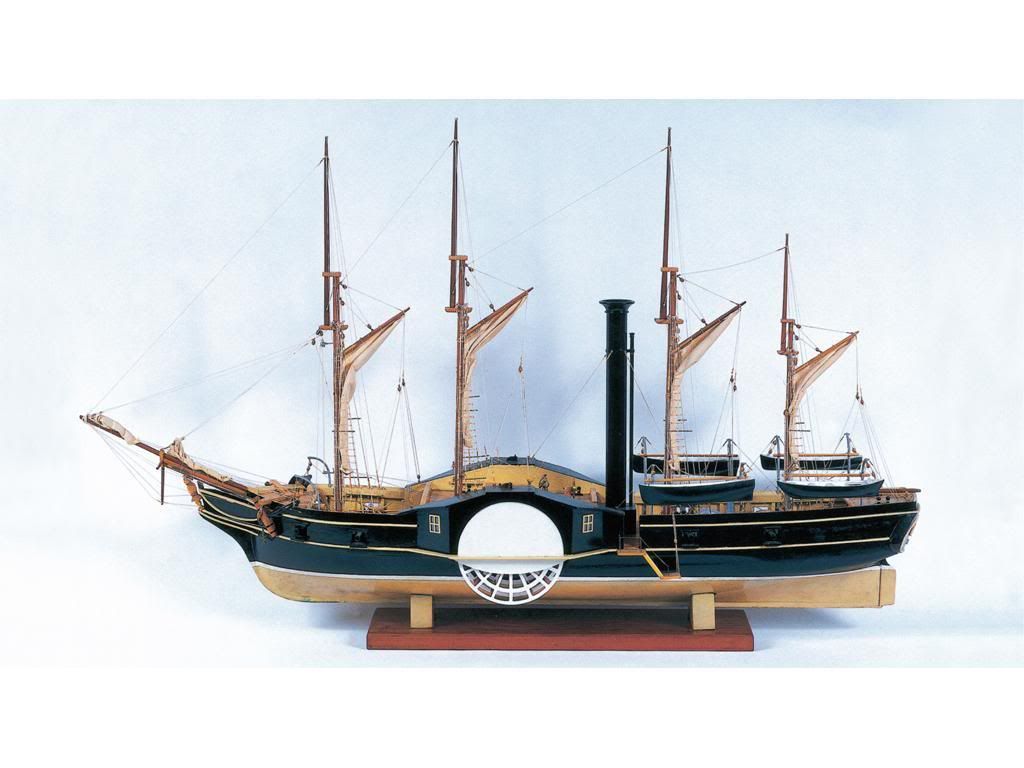
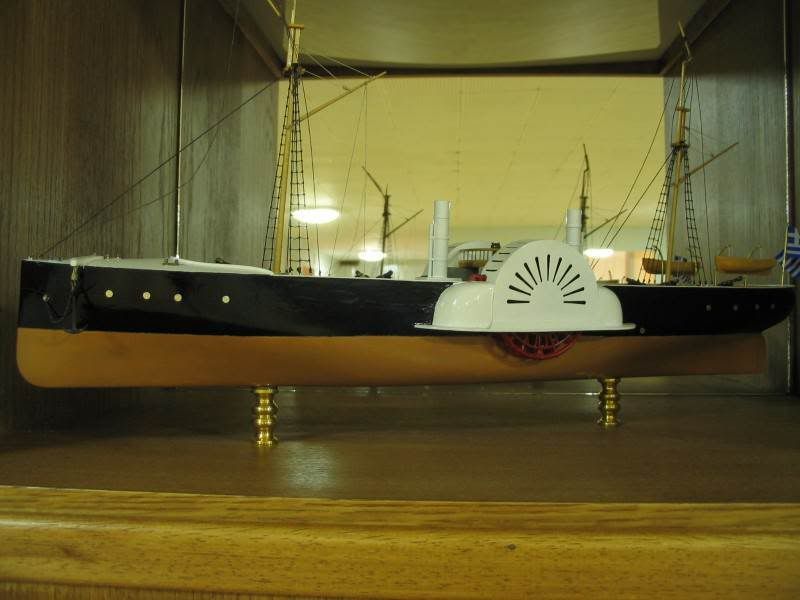
The first two images are of the model of Karteria by G. Vammenos, which can be seen at the Hellenic Maritime Museum, Piraeus. The third image is Karteria's model at the Hellenic Naval Academy's museum.

Model of Karteria by G. Vammenos Model of Karteria Model of Karteria by G. Vammenos